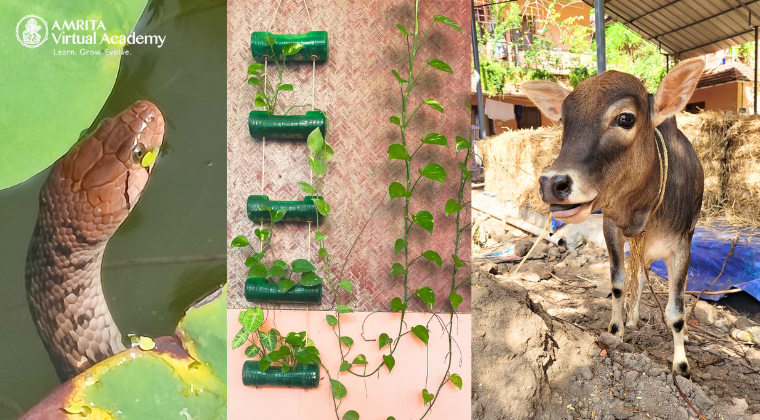
I was recently blessed to stay six months in Amritapuri, India, and do seva (“selfless service”) for Amrita Virtual Academy. Even though the seva was in an office there, I realized how closely connected we are to Nature in Amritapuri, at all times. There are trees, bushes, plants and birds almost everywhere. Even in the seva office, I could feel the breeze from the sea when the window was open, and, at times, I could see the smallest snake outside the window. (There was a mosquito net covering the window, so we always felt safe 🙂.) The ashram is surrounded by the backwaters and the Arabian sea, which you can see from the higher buildings or when you take a walk.
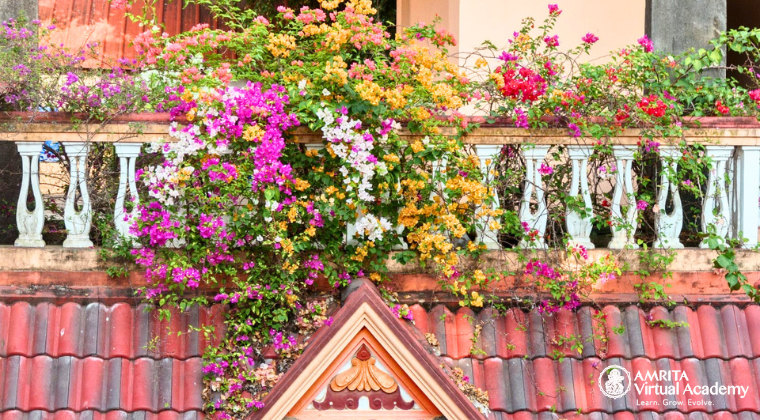
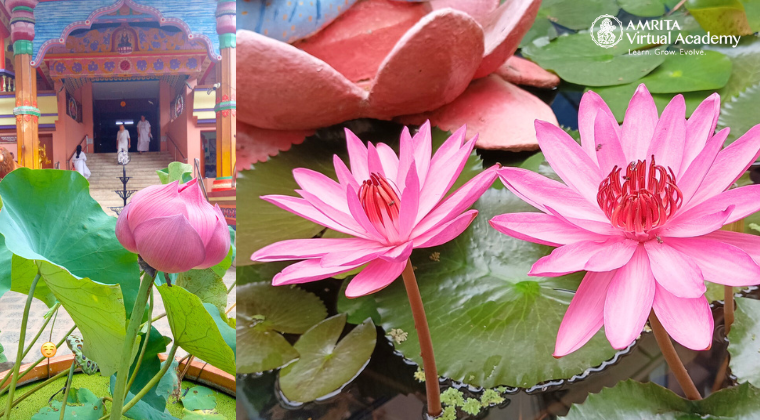
When you arrive at Amritapuri’s International Office, there are so many flowers and flowering bushes welcoming you, for example: the many bougainvilleas (pictured below). When you go a bit further through the gate, towards the temple (the heart of Amritapuri) the majestic peepal tree, with its heart-shaped leaves and all its birds, greets you, setting the tone of holiness of the place.
Even on the walls, by the Western Café, there are recycled bottles with hanging plants. Also the mango tree there is in full bloom and loaded with ripening mangoes now.
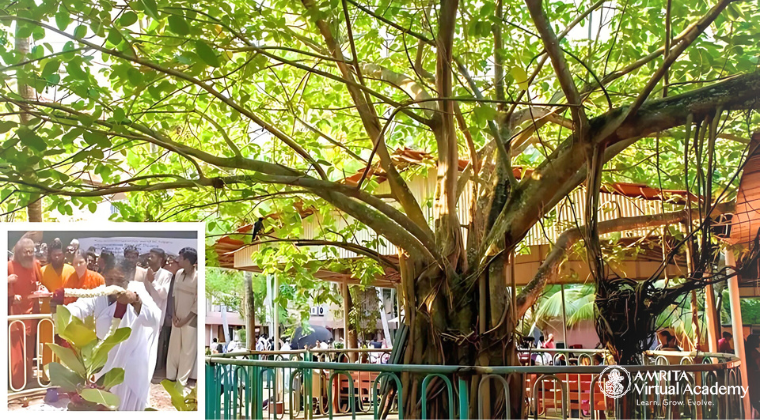
Next to the Indian Canteen, a sacred banyan tree stands grandly. Amma planted this tree in a ceremony during Amritavarsham 50 (the celebration of Amma’s 50th birthday), with water from rivers all over the world. (There is a video on Youtube from the Amritavarshan celebration, here.)
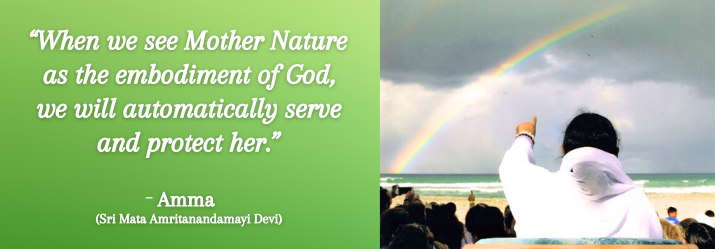
Even sitting in the big hall where Amma’s daily program is often conducted, you are surrounded by Nature. You can hear the wind, the rain, and the birds, as the structure does not have closed walls. These sounds, I find, are conducive for going within and help to give a feeling of connectedness with all of creation. The experience makes me think of this quote from Amma:
There is a rhythm to everything in the cosmos. The wind, the rain, the waves, the flow of our breath and heartbeat—everything has a rhythm. Similarly, there is a rhythm in life. Our thoughts and actions create the rhythm and melody. When the rhythm of our thoughts is lost, it reflects in our actions. This will, in turn, throw off the rhythm of life itself. Today, that is what we are seeing all around us.
-Amma (Sri Mata Amritanandamayi Devi)
The appreciation for the connectedness to Nature in Amritapuri, made me check into the Gardening and Nature content Amrita Virtual Academy offers. As I write this, summer is in full swing in India, and, of course, the weather is very different here than in more northern countries, like my home country of Sweden. But, gardening is a year-round activity, and it’s great to prepare in advance! And, summer is a great time for the preparation of seed saving. Winter is the time for the planning and planting of seedlings. Both subjects are covered in the AVA courses! There are so many ways to connect with Nature, both by being in nature and by gardening, so I wanted to see what the AVA library offers. As I found that the library is quite vast, I decided to make a compilation of the content, and share it with you, so you can easily check out whatever you feel drawn to!
Amma’s Garden & Message
A very special, intimate, and inspiring clip that I feel is a good start, is the Amma’s Garden & Message, a vlog with Amma. [AVA Members can click here to view it]. You can find it in the Satsang Library, where all the satsangs from Amrita Virtual Academy’s courses and retreats are archived and sorted by topic for easy viewing. This short vlog is one that everyone can enjoy, whether you are into gardening or not, as it gives you some precious moments with Amma.
There is also a sweet video from one of the rooftop gardens in Amritapuri that you can watch on YouTube. Vikasita gives you a relaxing and devotional tour among the plants and vegetables. Since the video is on Youtube, you can watch it whether you have joined the Amrita Virtual Academy membership or not. Watch the Amritapuri Terrace Garden Tour 🍅
Amritaculture – Gardening as a Spiritual Practice
“Amritaculture” is a series of devotional gardening courses taught by a global team of expert gardeners. They offer an in-depth approach to gardening for both beginners and seasoned growers. The courses are especially helpful if you have a place where you can garden, whether it’s outdoors or even indoors, with some pots by the window. Amritaculture can help you to make gardening a spiritual practice; to deepen your connection to Amma, to your own Self, and to all of Creation. It teaches you how to grow your own food, which Amma has stressed for many years as being important. The courses also aim to help you increase your love and devotion to Nature, which we know is very needed in this age, both for our own well-being, and for the well-being of the world.
Something great I found is, if you have any doubts throughout the process of gardening with Amritaculture, there are possibilities to ask questions in the AVA forum, and also a library of recorded Q&A sessions to see how other gardener’s trouble-shooted their gardening season with the AVA instructors.
Amritaculture’s “Grow and Serve” with Green Friends Australia [AVA Members can watch it here] is a special, short and heartfelt program where a family of three from Australia (Kalivati, Ribhu and little Suriya) share how they started a Community Garden project during the Covid-lockdown. They started by creating their own garden. Then, they looked to see if they could help others to do the same. Thus, they ended up helping devotees establish gardens, and from that point, the project grew bigger. Without telling the whole story, they are now serving a wider community along the Sunshine Coast!
Here you can read more about GreenFriends and projects around the globe. Maybe there is a group for you to join in your country, too!
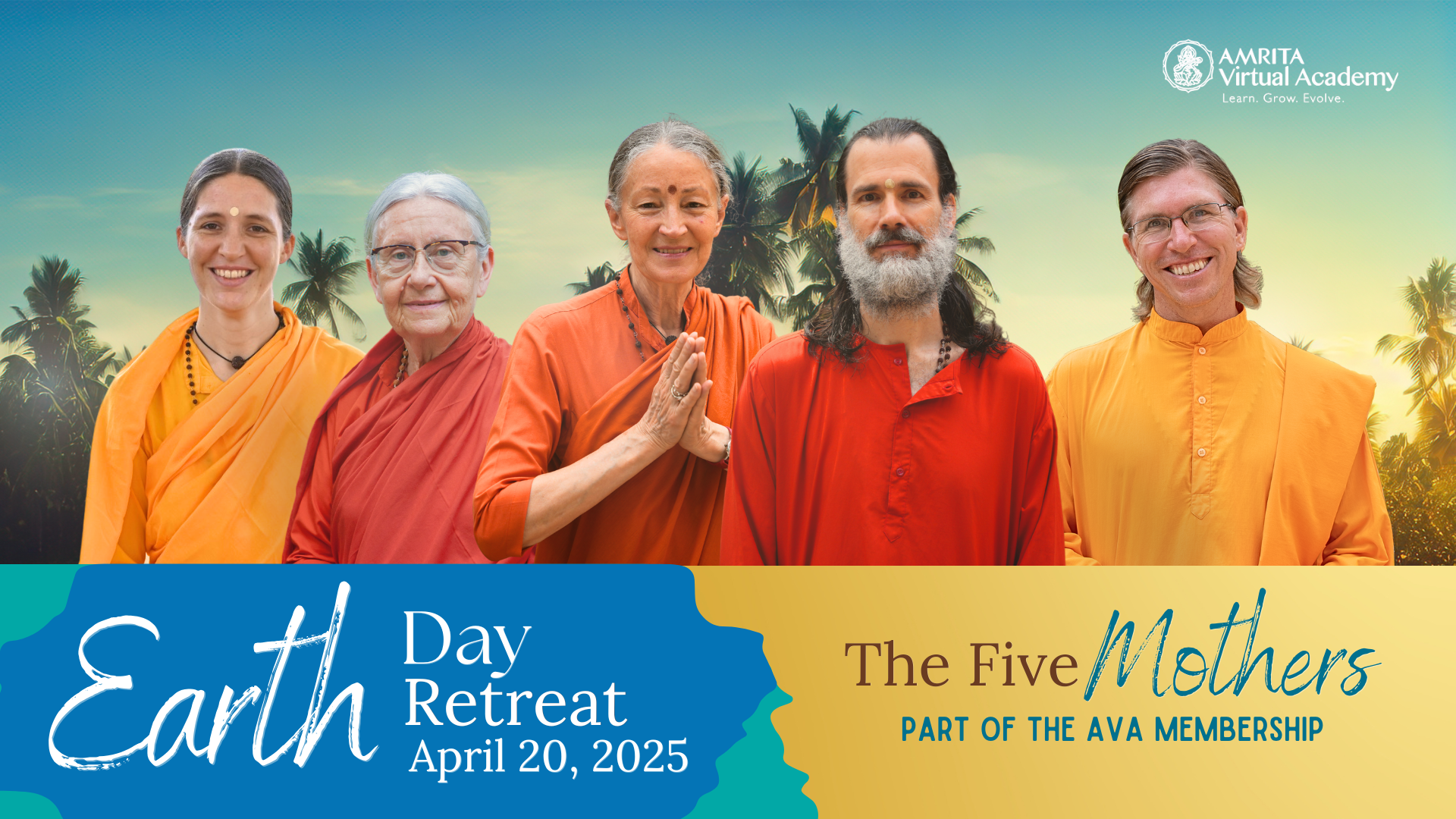
Earth Day Retreat – April 20, 2025
On April 20, there will be a brand new Earth Day Retreat in the AVA Membership. The title of the retreat is “The Five Mothers”. I am very curious what it will be like… Find out more here!
Inside the AVA Membership are also the one-day or two-day long Earth Day Retreats from 2023 and 2024! The retreats are titled, “Nurture Mother Nature” and “You are the Self-effulgent Sun”.
You can do the retreats with the guidance of a suggested schedule, or in a self-paced manner. The retreats offer an opportunity for focused sadhana, coupled with love for Nature. Within each retreat are sessions guided by many competent spiritual seekers, as well as senior swamis/swaminis. The sessions feature yoga, guided meditations, mantra japa, DIY sessions, and also sessions that teach you more about the culture Amma grew up in.
Natural Living: Workshop series
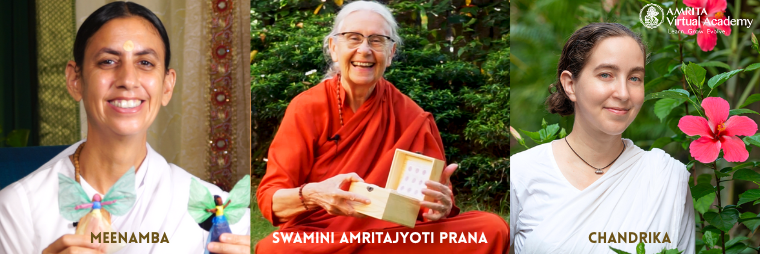
There is also the “Natural Living” workshop series, which includes high-quality DIY episodes, ranging from a workshop taught by French Swamini Amritajyoti Prana, presenting tips on how to use essential oils, to a workshop taught by Meenamba, who has led the great Amrita Upcycling project in Amritapuri since many years. Meenamba teaches how to make practical tote bags from recycled plastics, and much more. Our dear Tanmayi, from Amrita Virtual Academy, shares more about the “Natural Living” series in a blog she wrote while testing an episode. You can read about her experience here.
In the end, what I really enjoyed about the Nature and Garden content, is the mix of spiritual teachings and the practical application through different workshops and sessions that carry Amma’s way and message so well… high spirit, but feet on the ground!
What I want to mention also, is the valuable course about one of the foundations of our life: soil. In “Soul of the Soil”, Seetala and Chandrika teach on growing more organic food with less work by harnessing the power of microbiology. Learn to use current research methods on regenerative agriculture combined with love and respect for Nature’s perfect interplay.
Thanks to Nistula for sharing her inspiring experience with Amrita Virtual Academy.
We encourage you to join the Earth Day Retreat 2025 here. It is going to be a beautiful retreat about The Five Mothers of Ancient India. The retreat is part of the AVA Membership. As an Amrita Virtual Academy member, you have access to more than 80 different courses and retreats in different fields. Discover more about the AVA Membership here. Or sign-up here.
For almost two years I have been doing seva (“selfless service”) for Amrita Virtual Academy. And, since I rarely get to take any of the courses, I honestly got very curious about all that’s in the Amrita Virtual Academy Membership. I love almost all the topics I see, and want to know exactly what I can learn. So, I decided to try out the Membership for 24 hours, have fun, and take you along. You’re invited to join me as I share my weekend adventure with you!
SATURDAY NIGHT
To begin, let me first login, and take another look at the AVA Membership… On the Student Dashboard I see all kinds of courses presented right away. Hmm… What shall I choose? I’ve got to start somewhere. What I’ve been longing to check out are the “Natural Living: Health and Harmony” and “Art of Natural Plant Dyeing” courses, plus the “Amrita Prasadam Indian Cooking” and “Devotional Singing” courses. (I also work as a classical singer, so I am curious to dive more deeply into devotional singing.) Also, I looooove, love, love cooking, so I want to see the amazing recipes and videos of the Indian Cooking classes.
My only activity tonight is to look around the Student Dashboard, and watch some of the content, so I know what to plan for tomorrow. Let’s start with my absolute favorite, Natural Living!!!
Exploring the Wellness Course, “Natural Living: Health and Harmony”
Oooh, a prayer to Amma before the course starts. Love it!
And, the video shows the Ecoshop in Amritapuri! I’m in India now, so I can easily go there. But, I imagine if you are in the West, and you miss the ashram here, then seeing the Ecoshop can literally feel like AVA is bringing Amritapuri into your home.
Oooh, we can learn to make eco-friendly gifts that support nature!
Look, it’s my singing friend in the video! “Hi Tejasvini! You look so cute in your white-and-pink sari!”
Right, we are going to make Mist Sprays with Essential Oils! I have wanted to do that for so long. I don’t have the essential oils at home that she speaks about, but tomorrow I will check which oils I DO have, and then make a home-and-body spray! Yippie!
Okay, next…I would love to cook something this weekend from the Indian Cooking courses.
Oooee, what are these Vegan Bliss Balls in Natural Living?
Wait, what? I seriously have everything in my flat (apartment) to make these balls tomorrow! But you know, since I’m no longer tired, I’m going to start making them right away.
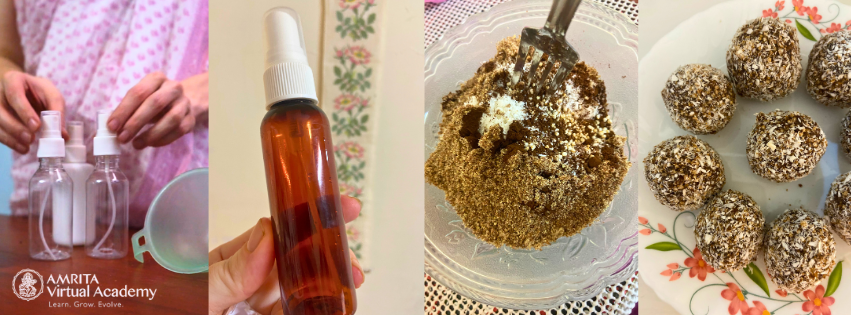
Looking in my kitchen I see I have 90% of the ingredients, and have decided to replace the oatmeal with puffed quinoa. First I mix the dry ingredients, then add the wet ingredients, and make the bliss balls. Wauw, they are delicious! And, so easy to make.
Well, after that, I am still energized, so I’m going to see if I have any essential oils to make the mist spray taught in the course. Hmmm, I don’t have any, except a few final drops. But, what I do have, is a brown, plastic spray bottle I can use for when I do have oils. (You can see a photo of the brown bottle above and a fabric strip of my mum’s embroidered roses pictured in the background.) I’m going to head over to the Ecoshop in the coming days, and check if I can get some affordable oils to make my own spray. We will be going on tour with Amma soon, so I don’t want to spend too much now.
SUNDAY MORNING
Learning Indian Cooking with the “Amrita Prasadam” Courses
There are so many wonderful Amrita Prasadamvideos and recipes to choose from! I decided to make dosas, and check out the recipe for Coconut Chutney. Cool—all the recipe videos are right there on the Cooking page. (I clicked on “Cooking” in the left menu, on the Student Dashboard to bring up the Cooking page. I could also just type “coconut chutney” in the search bar to get there.) And, there is a video with the recipe: “Masala Dosa & Coconut Chutney”. Right, I see this is high-level Indian cooking. This is a great recipe for coconut chutney, but I don’t have everything needed in my little kitchen, so let’s make it with what I have! Yeah! It turned out to be yummy. Thank you, Vaju! <3
The prayer to Amma in the beginning is really awesome. Since we do it before every seva in the ashram, it becomes a regular part of life. Also, it’s beautiful how the focus of the singing course is on connecting more to Amma by singing bhajans. Ooo… I see it’s a course for 8 weeks.
I looked quickly through it and saw videos with all kinds of vocal exercises to learn ragas. (A raga is like a set of rules for building a melody—very similar to the Western concept of a music scale or mode.)
Wauw! I wanna learn this. And you know what’s amazing? You can make a video of yourself, and send it in to the teaching assistant to get feedback on your singing! In the coming weeks I will continue taking this singing course with Ratna. (She’s Brahmachari Ramanandamritaji’s sister!) I have seen the satsang, “The Essence of Music”, with Swami Amritaswarupananda Puri in the past weeks, and it is just gold! A must watch for music lovers.
SUNDAY EVENING
Enjoying The Art of Natural Plant Dyeing
Now, finally I can go into The Art of Natural Plant Dyeing! I was ‘dying’ to dive into this one… Okay, I see now that the course includes 12 hours of videos. So, let’s get started!
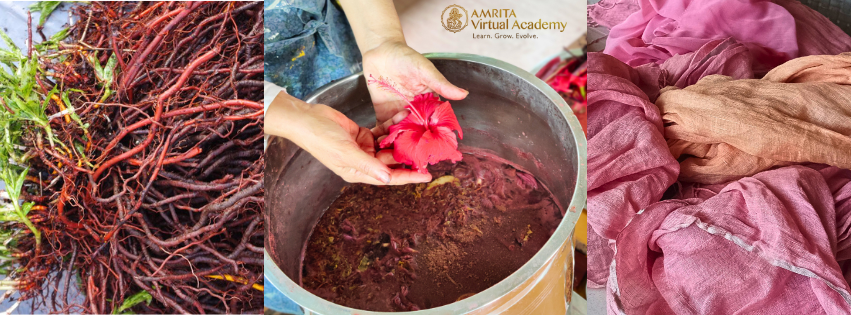
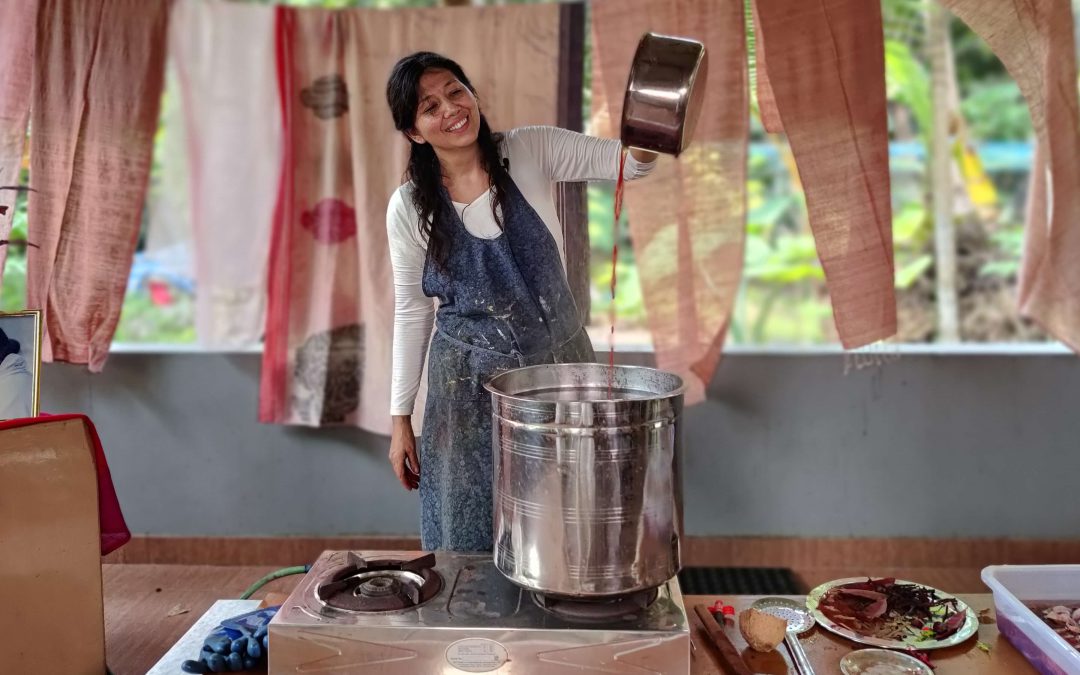
This whole course was recorded here in Amritapuri, in the Saraswati house—a place not everybody knows of yet. I was there a while ago, and it felt as if I went into the forest to see the medicine lady (the good witch) of the village to learn about the healing properties of different plants and herbs.
The sevites (volunteers) in the Saraswati house make all kinds of beautiful clothes with fabrics and natural dyes—one of the ultimate feminine and natural spots in Amritapuri.
Ayurvastra is an old ‘craft’ or ‘science’ about the healing art of natural plants in fabric. I learned from the class that it takes far more time to dye fabrics this way than it does to dye fabrics for the clothes we buy in regular shops. But, it is so healing for us, and also for the environment. “Fast fashion” becomes landfill garbage. I would love a sari dyed with Ayurvastra! Also in the Amrita Boutique here in Amritapuri, garments are sold that are made by Padma, who volunteers in the Saraswati house. (You can see her in the photo here, along with our Mindful Movement instructor, Neelima.)
Like Devotional Singing, Art of Natural Plant Dyeing is an 8-week course. I will be watching it in parts in the coming weeks, since I don’t want to overload myself now.
CONCLUSION
I’ve learned it’s especially good if you can join the year-long AVA Membership option, because, dear Goddess, it’s so beautiful, all this content! Soooo much valuable learning, plus arts and crafts…I am so grateful I have found this.
I didn’t even get into the language courses, the retreats, and the gardening courses yet. This is a true treasure chest of knowledge, with amazing spiritual lessons and satsangs everywhere you look! Truly “Learning Values Through the Arts!”
Love, Tanmayi Netherlands
P.S. Hey, that’s me in the AVA Membership… Ooooh It’s from my own little singing course…
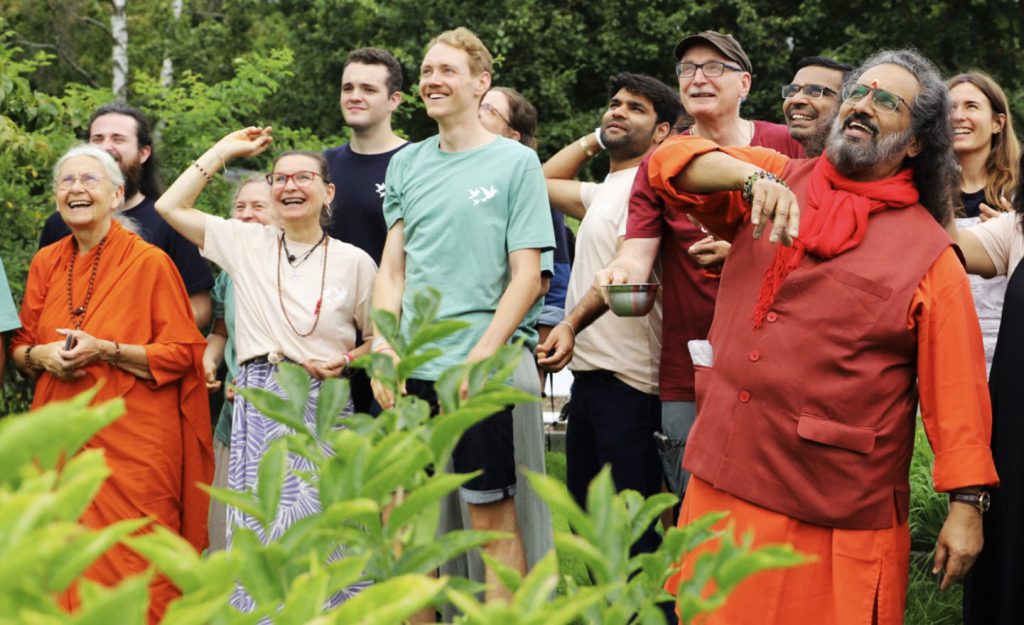
In what world does a grassroots environmental initiative like “seedball tossing” involve the in-person participation of the President of India, Smt Droupadi Murmu, thousands of participants, and many other important government leaders, with only a couple days’ notice? In the inspiring world of Civil 20, 2023! This is one event of many in the Global Seedball Campaign, one initiative of Amma’s C20 efforts in Sustainable and Resilient Communities.
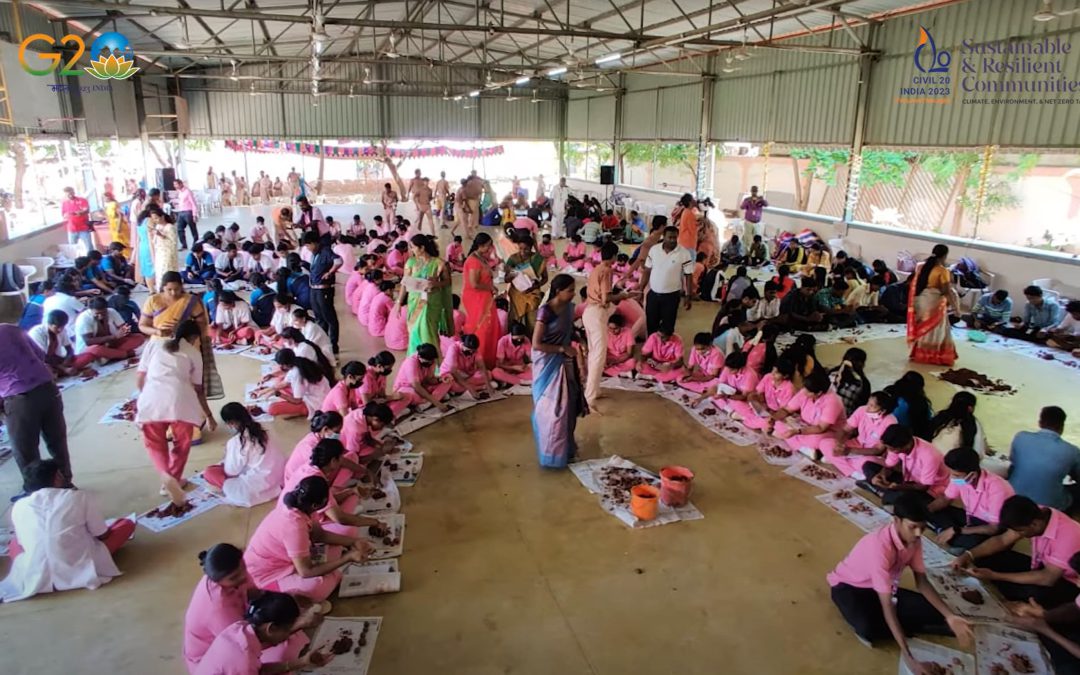
The making and distribution of seedballs Putting some seeds in a ball of manure or compost and soil is an ancient technique for reforestation and soil restoration that offers a way for community groups to come together and contribute to restoring our planet’s ecological balance. Seedballs can be thrown into areas needing restoration—or dropped from helicopters or planes!
Under the guidance of Amma, Sri Mata Amritanandamayi Devi, the Chair of Civil 20 during India’s 2023 G20 Presidency, the Working Group for Sustainable & Resilient Communities partnered with AYUDH (the youth wing of Mata Amritanandamayi Math) to launch the C20 Global Seedball Campaign. The goal was to make, and toss, 1 million seedballs worldwide. Globally, volunteers gathered at Embracing the World centers across India, and in Asia, Europe, South America, North America, Australia, and Africa as part of an effort to encourage people to contribute to this goal in whatever way possible. Other organizations, including the Government of Puducherry, private schools and colleges, and even businesses who wished to contribute to their communities, joined in the campaign.
In a way, the global campaign itself is a metaphorical seedball. The idea for the campaign was the seed, and the spread of that idea throughout Embracing the World centers across the world, to other organizations and businesses, is akin to the spread and rooting of that seed.
Seedballs mimic nature by providing protection and fertilizer for the seeds inside. If you’ve ever seeded a garden and watched birds swoop in and eat most of the seeds, you can probably see why the coating around the seeds is protective in more than one way.
On August 7, 2023, President Murmu graced the C20 Global Seedball Campaign, along with many government officials and dignitaries (see partial list below), at the Thirukanchi Temple in Puducherry, India. She inaugurated the Seedball Dispersal initiative by tossing the first seedballs made by Puducherry students, to help with reforestation at the Temple grounds.
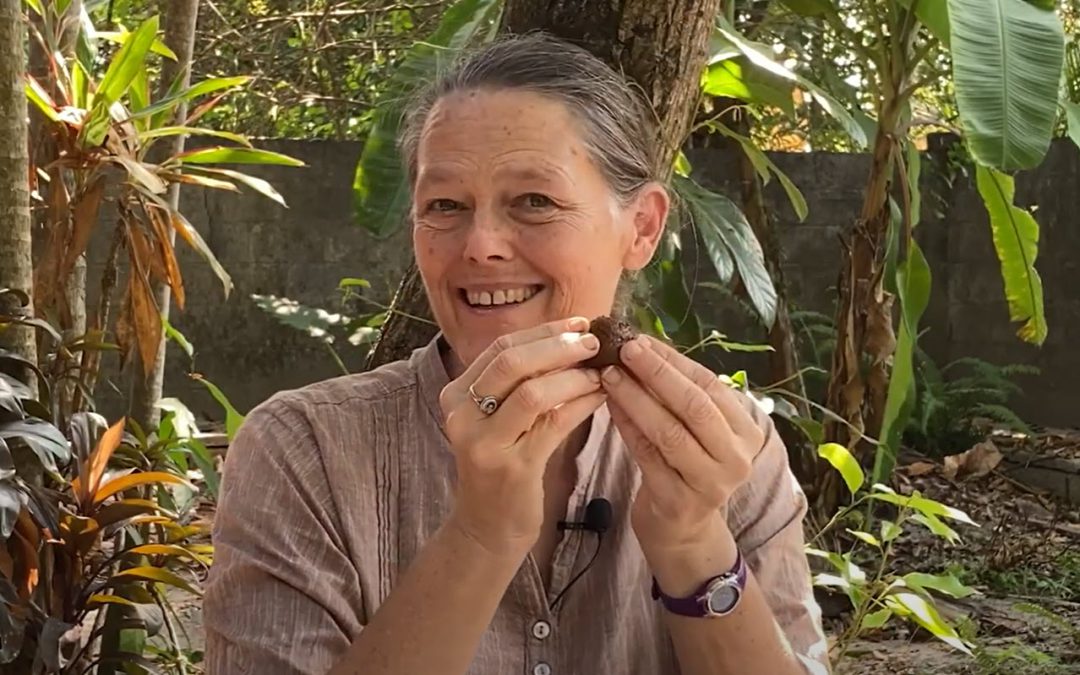
The event, originally envisioned as a simple series of workshops and classes for students and members of the NCC (National Cadet Corps), grew like, well, fertile seedballs, into a huge event with 5,000 student participants from Puducherry government and private schools and colleges, as well as volunteers from all over Tamil Nadu. Amrita Virtual Academy also joined in to support the effort. Chandrika Suliman, an educator with the Amritaculture gardening and ecology classes, was an organizer for the event.
With the power of grassroots organization, youthful passion and the hope the project embodies, word spread quickly. Eventually the campaign distributed 500,000 seedballs across vulnerable ecosystems in the area around Puducherry and Tamil Nadu. Other cities, like Coimbatore, Chennai, have since held similar events—the power and passion initiated by the Puducherry event resulted in both vitally needed environmental reforestation and education, while also being a widely noticed example of cooperation and collaboration across many different organizations and levels of government, citizens, and NGOs. The whole world needs such examples of sincere gatherings and outpourings of cooperation and hope.
In addition to President Murmu, the event included esteemed guests such as Dr. (Tmt). Tamilisai Soundararajan, Hon’ble Lt. Governor of Puducherry; Shri Thiru. N. Rangasamy, Chief Minister of Puducherry; Shri Thiru. C. Djeacoumar, Hon’ble Minister for Agriculture and Forest, Puducherry; and Swami Ramakrishnananda Puri, Treasurer, Mata Amritanandamayi Math. Students from government schools, private schools, medical college students, arts college students, NSS and NCC students were among the participants.
For information about the inauguration of the program in Puducherry on July 21, 2023, just two weeks before the event described above, please see the video below:
https://www.youtube.com/watch?v=X3qBAaw3PYw
Globally the campaign has taken many forms. For example, at the19th Annual European AYUDH Forum, in August, 2023, Swami Amritaswarupananda Puri led the group in a seedball distribution in which seedballs were made and planted around the German ashram.
See how the Indian Navy has tossed the seedballs from helicopters over degraded forest areas, to show their support for the C20 Global Seedball Campaign:
Every year, humans destroy around 10 million hectares of forests, causing huge ecological imbalance that affects earth’s climate and biodiversity. Deforestation has a profound impact on mankind, wildlife, and other life forms in nature.
As deforestation continues, urgent action is needed to protect the planet’s biodiversity and ensure the survival and wellbeing of countless species on earth.
The Civil 20 working group on Sustainable & Resilient Communities (SRC), under the guidance and vision of Amma as Chair of C20 for India’s G20 Presidency, is deeply honored to launch a ‘Global Seedball Campaign’ that will work towards producing and distributing 1 million seeds of hope in the year 2023.
A seedball is made up of soil and seeds, often mixed with clay and other organic materials to hold the ball together. They are designed to be thrown or scattered in areas where vegetation is desired and rely on natural rainfall to germinate and grow into mature plants. This is an ancient technique used for reforestation and soil restoration. Seedballs offer an environmentally friendly and low-cost solution to a global problem and has the potential to make a significant impact on the health and resilience of our planet’s ecosystems.
https://www.youtube.com/watch?v=HsCZbprbLr8
Amrita Virtual Academy offers this video tutorial with step-by-step instructions to join in on the challenge. May the spread of seedballs and increased awareness of the importance of trees lead to restoring ecological balance.
When the 2023 G20 Summit convenes on September 9-10 in New Delhi, the leaders of the world’s major economies, comprising 19 countries and the European Union, will address the major global issues of our time.
The Government of India holds the G20 presidency for 2023, and has appointed Amma (Mata Amritanandamayi) as the chair of an official G20 engagement group known as Civil20, or C20. As a platform for Civil Society Organizations (CSOs), C20 will bring forth non-government and non-business voices and present specific policy recommendations to the world leaders gathering in New Delhi for this year’s G20 summit.
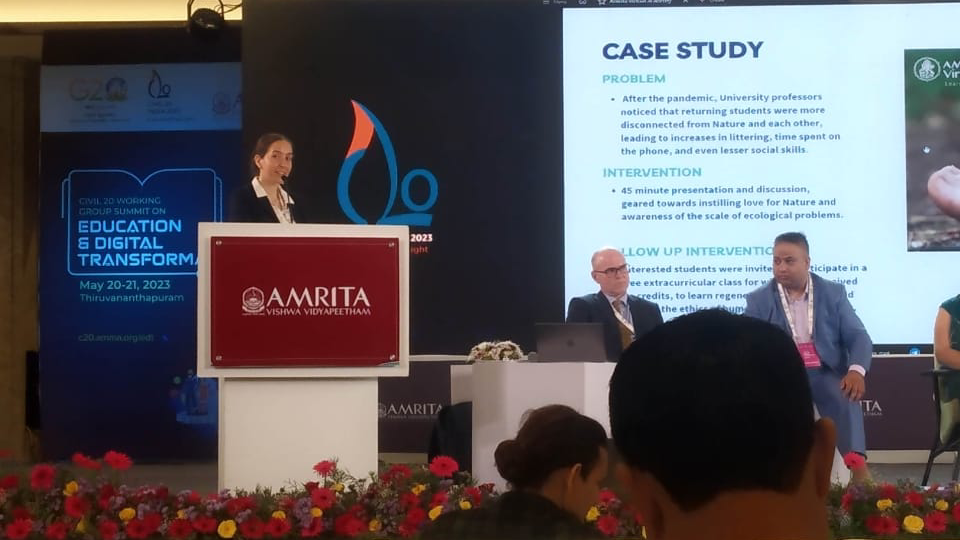
Since Amma’s appointment as C20 Chair, numerous C20 conferences have catalyzed new levels of collaboration and problem solving among civil organizations. It is within this significant global framework that the C20 Education & Digital Transformation Summit was held on May 20-21, 2023 in Trivandrum, Kerala. The event featured 66 speaker presentations by prominent leaders in this field—including one highlighting the work and vision of Amrita Virtual Academy (AVA).
AVA educator and program coordinator Chandrika Suliman began her presentation by sharing what makes Amrita Virtual Academy unique: that every course offering is rooted in spiritual values. As a result, AVA students experience growth well beyond the knowledge and skills acquired.
Chandrika then presented a case study demonstrating the power of such an approach. The case study highlighted a collaboration between AVA and Amrita University, initiated during the pandemic, when Amrita University professors observed that their Computer Science students had become disconnected from the natural world. The professors noticed campus littering was on the rise. And with students glued to their laptop and phone screens, social skills had also diminished. In hopes of reversing this trend, Chandrika was requested to give a 45-minute presentation on love for nature. Amazingly, just after the presentation 200 of the 400 attendees signed up to learn the principles of Regenerative Agriculture through an AVA Amritaculture curriculum.
Of those students who were accepted into the pilot program, 72% not only completed the course, but also wanted to continue learning and become youth leaders in the field of ecology and regenerative agriculture.
“People are longing to return to a harmonious relationship with nature,” Chandrika observed. “In this time of climate crisis, people are longing to move beyond the feelings of despair and hopelessness, and into an experience of connection and empowerment. As Amma encourages, ‘Light your little candle and step forward.’ This pilot course was a beautiful way to help people know how to do that.”
She continued, “What I learned from those 200 students, who were so eager to contribute back to nature, is that there’s still hope. There’s still hope, and we just need to be intelligent and loving and keep moving forward.”
By Amma’s grace, may the course offerings of Amrita Virtual Academy continue to ignite such optimism and determination within us all.
The skin is the largest organ of the human body, protecting us from the outside world and eliminating toxins from the body. We also absorb external substances through our skin. So what if the clothing we wear, which touches the skin all day, could help us feel healthy, well, and balanced? Can cloth carry medicinal properties? Did you know this is possible through the practice of Ayurvastra, an ancient spiritual science of dyeing textiles with medicinal herbs?
Ayurvastra is a Sanskrit term. “Ayur” means health and “vastra” means cloth, so the term translates to “healthy cloth.” This is a branch of Ayurveda (the science of life and longevity) stretching back 5,000 years.
Medicinal clothing as a means to protect and heal is a practice described in the Rigveda, a sacred Hindu text first composed in written form around 1,500 BC. Various Ayurvedic works state that even 100 years ago, many people in various parts of India were still practicing natural dyeing, repeatedly dipping their clothing in herb-based washes. In some parts of South India such as Kerala (where Amma’s ashram is), Ayurvedic, herbal-dyed cloths are still used to carry a newborn child. These special cloths have antibacterial qualities.
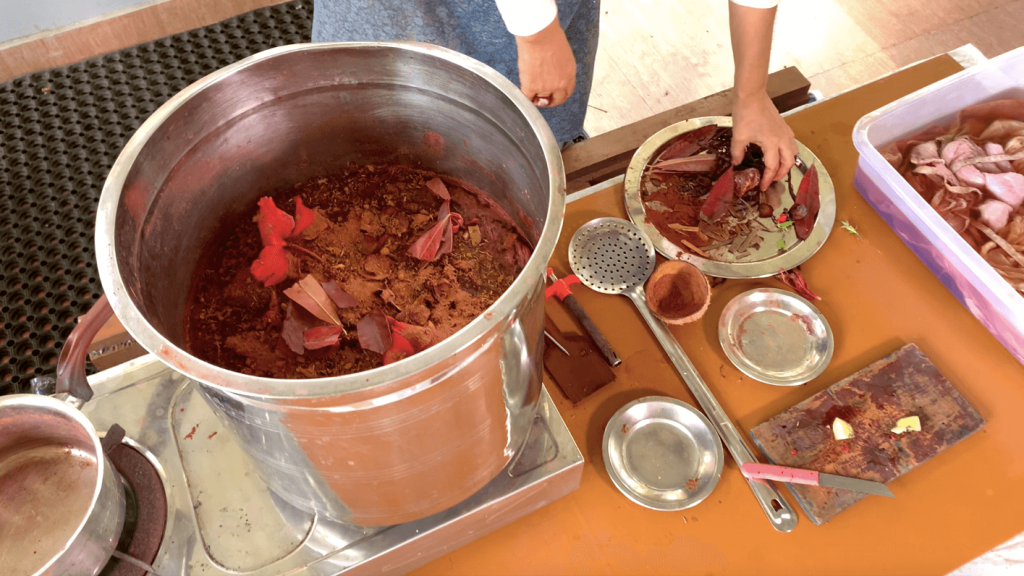
The creation of Ayurvastra clothing is precisely controlled. One hundred percent organic cotton is hand-loomed with no processing or additives. The fibers must be biodegradable and spun with no chemical finishes. To create subtle, yet beautiful colors, the all-natural cotton or yarn is bleached with a cow urine-based preparation which has great medicinal value. After the fabric is dried in direct sunlight, a gumming substance is applied, which contains extracts of plants such as aloe vera and camphor. The fabric is then cooked for several hours in “kashaya,” a concoction containing up to 60 medicinal herbs, plants, flowers, roots, barks and oils, all specifically selected for their wellness benefits. The fabric is left to dry for three days and then cured for 15 days, allowing the kashaya to settle into the fabric. It is then washed and dried in the shade and allowed to mature for another 15 days. The entire process is organic and environmentally friendly.
Traditionally, people used herbal-dyed cloths to boost immunity, and also to treat specific illnesses like arthritis, skin disorders, and diabetes. For diabetes, the herbal dye might include the “touch-me-not” flower, cumin seeds, champa flowers, and shoe flowers. An herbal dye for arthritis would be prepared with curry leaves; for skin diseases, turmeric, neem, and sandalwood would be combined to create the dye.
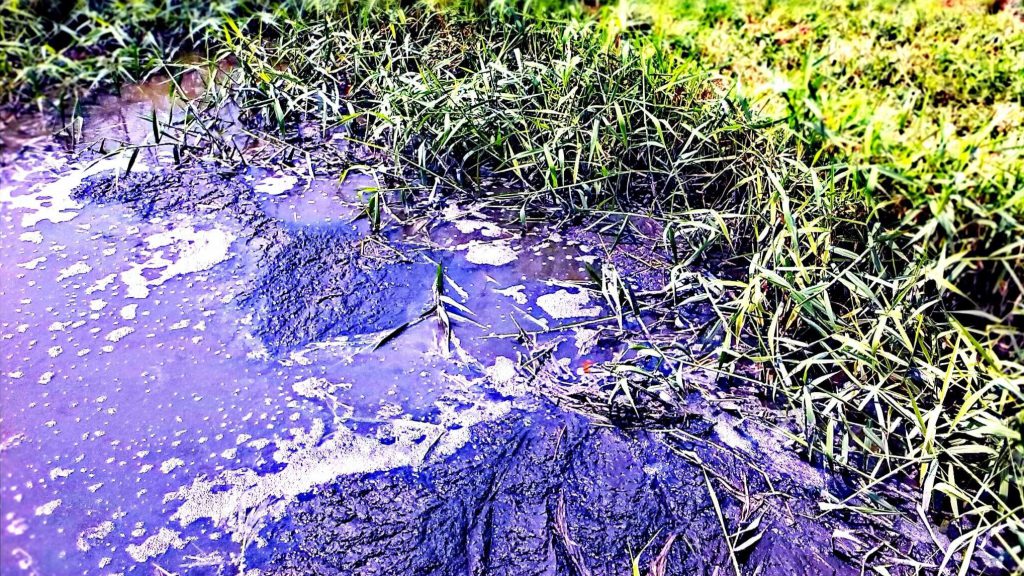
Ayurvastra differs significantly from modern textile dyeing — which is typically only for color, with no thought of medicinal value and no concern for the environmental damages created by the dyeing process. In fact, it is estimated that 20% of global clean water pollution comes from dyeing and finishing during textile production.
Ayurvastra differs from modern dyeing because in today’s age we dye for the color, but here in Ayurvastra they treat the garment for the wellness benefits, not so much to obtain a specific color.
By contrast, Ayurvastra not only benefits humanity, it is in every way honoring nature. This beautiful art form, embedded in the rich culture of India, is a practice of living harmoniously with the environment.
We hope you can join us in The Art of Natural Plant Dyeing course, offered with love from Amrita Virtual Academy. It was filmed from our special Saraswati garden in Amritapuri where we do natural plant dyeing year-round.