Every year, humans destroy around 10 million hectares of forests, causing huge ecological imbalance that affects earth’s climate and biodiversity. Deforestation has a profound impact on mankind, wildlife, and other life forms in nature.
As deforestation continues, urgent action is needed to protect the planet’s biodiversity and ensure the survival and wellbeing of countless species on earth.
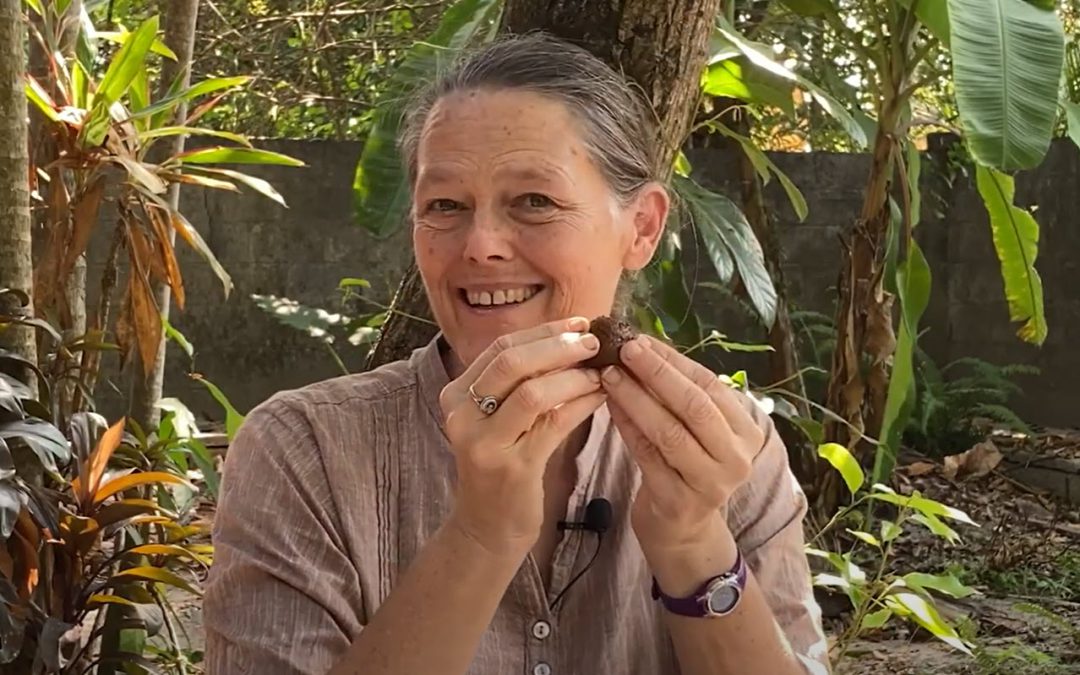
The Civil 20 working group on Sustainable & Resilient Communities (SRC), under the guidance and vision of Amma as Chair of C20 for India’s G20 Presidency, is deeply honored to launch a ‘Global Seedball Campaign’ that will work towards producing and distributing 1 million seeds of hope in the year 2023.
A seedball is made up of soil and seeds, often mixed with clay and other organic materials to hold the ball together. They are designed to be thrown or scattered in areas where vegetation is desired and rely on natural rainfall to germinate and grow into mature plants. This is an ancient technique used for reforestation and soil restoration. Seedballs offer an environmentally friendly and low-cost solution to a global problem and has the potential to make a significant impact on the health and resilience of our planet’s ecosystems.
https://www.youtube.com/watch?v=HsCZbprbLr8
Amrita Virtual Academy offers this video tutorial with step-by-step instructions to join in on the challenge. May the spread of seedballs and increased awareness of the importance of trees lead to restoring ecological balance.
When the 2023 G20 Summit convenes on September 9-10 in New Delhi, the leaders of the world’s major economies, comprising 19 countries and the European Union, will address the major global issues of our time.
The Government of India holds the G20 presidency for 2023, and has appointed Amma (Mata Amritanandamayi) as the chair of an official G20 engagement group known as Civil20, or C20. As a platform for Civil Society Organizations (CSOs), C20 will bring forth non-government and non-business voices and present specific policy recommendations to the world leaders gathering in New Delhi for this year’s G20 summit.
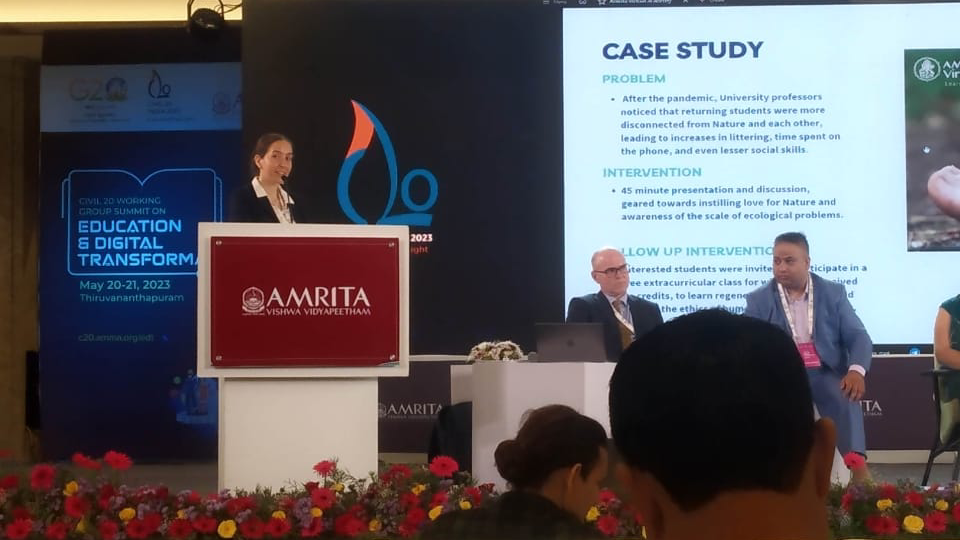
Since Amma’s appointment as C20 Chair, numerous C20 conferences have catalyzed new levels of collaboration and problem solving among civil organizations. It is within this significant global framework that the C20 Education & Digital Transformation Summit was held on May 20-21, 2023 in Trivandrum, Kerala. The event featured 66 speaker presentations by prominent leaders in this field—including one highlighting the work and vision of Amrita Virtual Academy (AVA).
AVA educator and program coordinator Chandrika Suliman began her presentation by sharing what makes Amrita Virtual Academy unique: that every course offering is rooted in spiritual values. As a result, AVA students experience growth well beyond the knowledge and skills acquired.
Chandrika then presented a case study demonstrating the power of such an approach. The case study highlighted a collaboration between AVA and Amrita University, initiated during the pandemic, when Amrita University professors observed that their Computer Science students had become disconnected from the natural world. The professors noticed campus littering was on the rise. And with students glued to their laptop and phone screens, social skills had also diminished. In hopes of reversing this trend, Chandrika was requested to give a 45-minute presentation on love for nature. Amazingly, just after the presentation 200 of the 400 attendees signed up to learn the principles of Regenerative Agriculture through an AVA Amritaculture curriculum.
Of those students who were accepted into the pilot program, 72% not only completed the course, but also wanted to continue learning and become youth leaders in the field of ecology and regenerative agriculture.
“People are longing to return to a harmonious relationship with nature,” Chandrika observed. “In this time of climate crisis, people are longing to move beyond the feelings of despair and hopelessness, and into an experience of connection and empowerment. As Amma encourages, ‘Light your little candle and step forward.’ This pilot course was a beautiful way to help people know how to do that.”
She continued, “What I learned from those 200 students, who were so eager to contribute back to nature, is that there’s still hope. There’s still hope, and we just need to be intelligent and loving and keep moving forward.”
By Amma’s grace, may the course offerings of Amrita Virtual Academy continue to ignite such optimism and determination within us all.
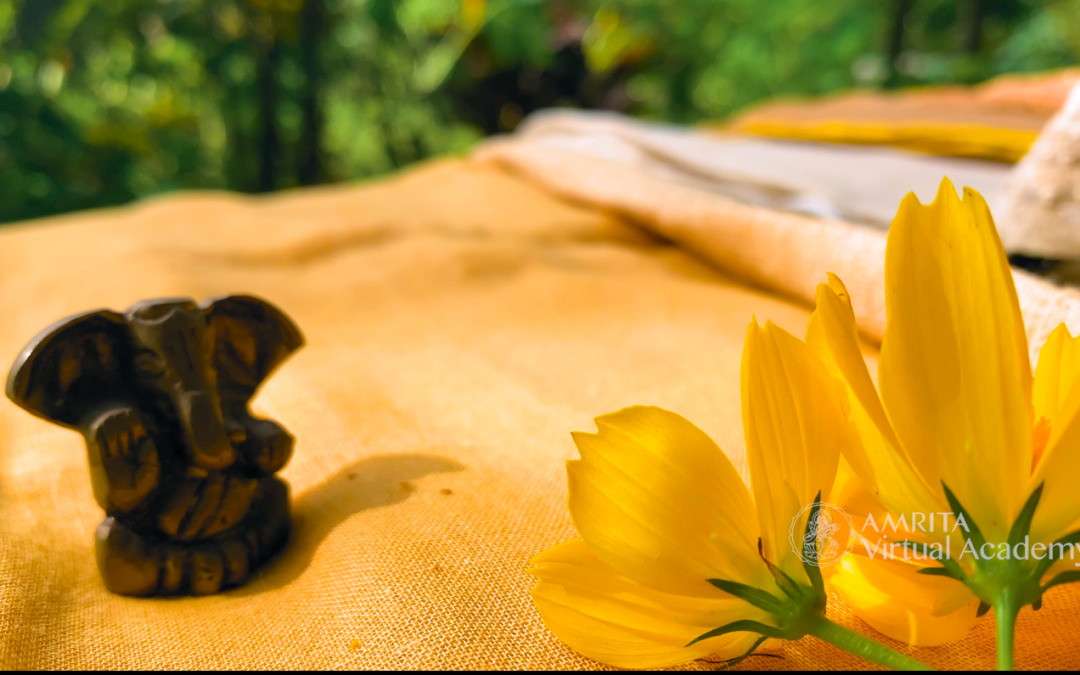
The skin is the largest organ of the human body, protecting us from the outside world and eliminating toxins from the body. We also absorb external substances through our skin. So what if the clothing we wear, which touches the skin all day, could help us feel healthy, well, and balanced? Can cloth carry medicinal properties? Did you know this is possible through the practice of Ayurvastra, an ancient spiritual science of dyeing textiles with medicinal herbs?
Ayurvastra is a Sanskrit term. “Ayur” means health and “vastra” means cloth, so the term translates to “healthy cloth.” This is a branch of Ayurveda (the science of life and longevity) stretching back 5,000 years.
Medicinal clothing as a means to protect and heal is a practice described in the Rigveda, a sacred Hindu text first composed in written form around 1,500 BC. Various Ayurvedic works state that even 100 years ago, many people in various parts of India were still practicing natural dyeing, repeatedly dipping their clothing in herb-based washes. In some parts of South India such as Kerala (where Amma’s ashram is), Ayurvedic, herbal-dyed cloths are still used to carry a newborn child. These special cloths have antibacterial qualities.
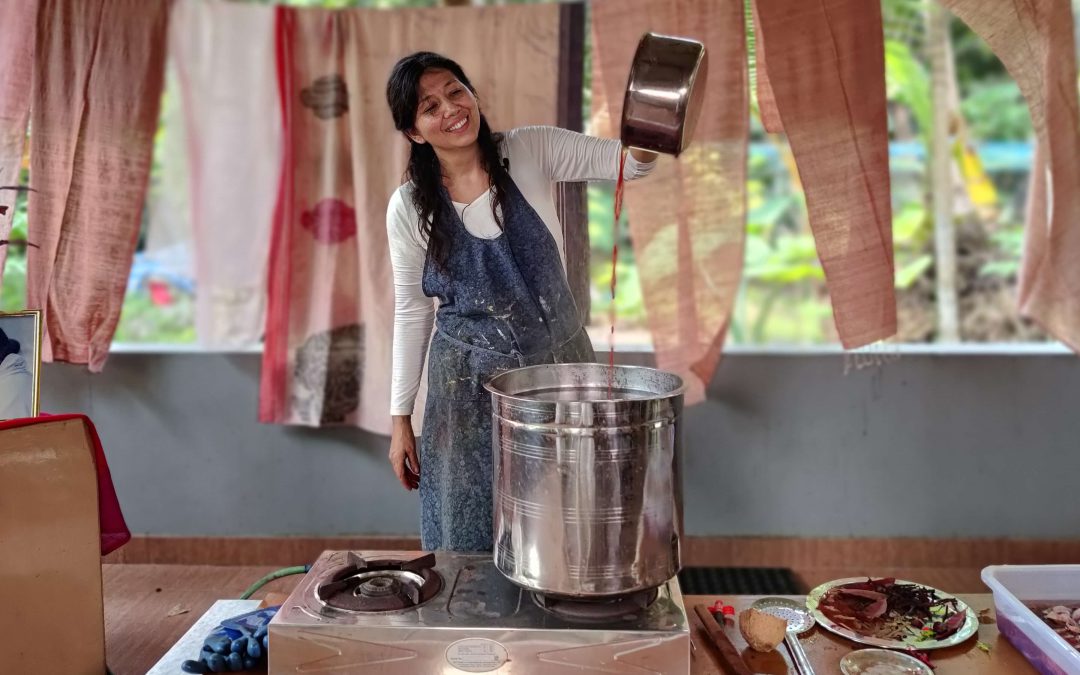
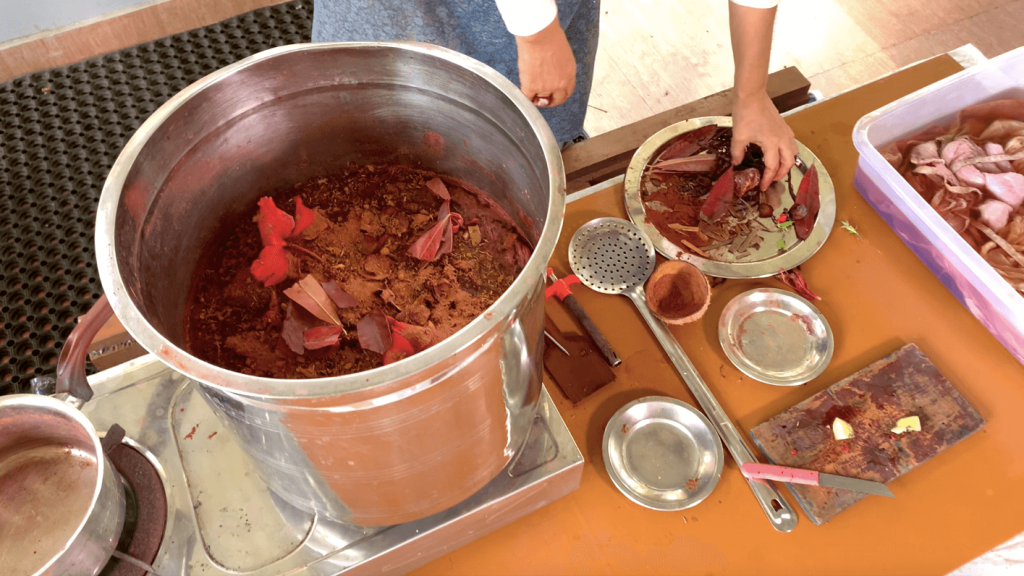
The creation of Ayurvastra clothing is precisely controlled. One hundred percent organic cotton is hand-loomed with no processing or additives. The fibers must be biodegradable and spun with no chemical finishes. To create subtle, yet beautiful colors, the all-natural cotton or yarn is bleached with a cow urine-based preparation which has great medicinal value. After the fabric is dried in direct sunlight, a gumming substance is applied, which contains extracts of plants such as aloe vera and camphor. The fabric is then cooked for several hours in “kashaya,” a concoction containing up to 60 medicinal herbs, plants, flowers, roots, barks and oils, all specifically selected for their wellness benefits. The fabric is left to dry for three days and then cured for 15 days, allowing the kashaya to settle into the fabric. It is then washed and dried in the shade and allowed to mature for another 15 days. The entire process is organic and environmentally friendly.
Traditionally, people used herbal-dyed cloths to boost immunity, and also to treat specific illnesses like arthritis, skin disorders, and diabetes. For diabetes, the herbal dye might include the “touch-me-not” flower, cumin seeds, champa flowers, and shoe flowers. An herbal dye for arthritis would be prepared with curry leaves; for skin diseases, turmeric, neem, and sandalwood would be combined to create the dye.
Ayurvastra differs significantly from modern textile dyeing — which is typically only for color, with no thought of medicinal value and no concern for the environmental damages created by the dyeing process. In fact, it is estimated that 20% of global clean water pollution comes from dyeing and finishing during textile production.
Ayurvastra differs from modern dyeing because in today’s age we dye for the color, but here in Ayurvastra they treat the garment for the wellness benefits, not so much to obtain a specific color.
By contrast, Ayurvastra not only benefits humanity, it is in every way honoring nature. This beautiful art form, embedded in the rich culture of India, is a practice of living harmoniously with the environment.
We hope you can join us in The Art of Natural Plant Dyeing course, offered with love from Amrita Virtual Academy. It was filmed from our special Saraswati garden in Amritapuri where we do natural plant dyeing year-round.
Have you ever wondered about how U-Pick farms work? Here’s a fun and informative Q & A with Anaswara, our expert U-Pick farmer who shares her years of expertise in U-pick farming.
Q 1. What is an organic U-Pick farm?
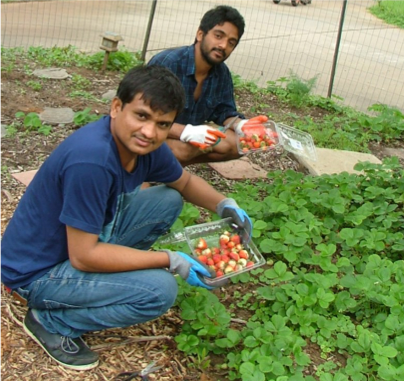
On an organic U-Pick picking farm, participants pick their own produce. They learn how to recognize and harvest their own produce instead of receiving a CSA box each week. A picking farm is a form of Community Supported Agriculture. CSA’s usually deliver a box of food to families once a week. Many consumers in a regular CSA feel they get too much of some produce and not enough of others, and it’s sometimes wilted. With our organic picking farm, everyone harvests only what they want and need. The freshest produce is available at its nutritional peak. Pickers understand they pick only for their family and produce is for immediate consumption, not for canning, freezing, or drying. Our pickers have been very conscious and honest. If one cares about eating healthy food, perhaps one is more likely to be ethical and fair.
U-pick farming is the hope for the future for small farmers. On a picking farm, participants pay for a year in advance and then come to pick when it’s convenient for them. This gives the small farmer start-up money to buy seed and hire help to plant and tend the veggies.
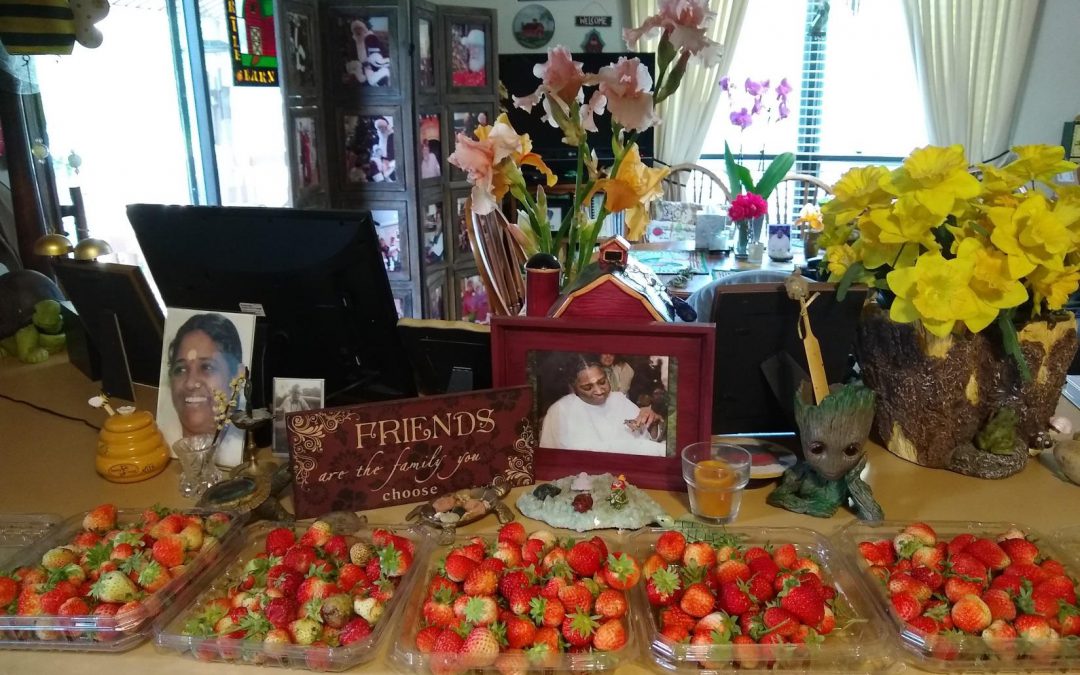
Nature’s abundance for all.
All my farmer friends told me this wouldn’t work, and it has worked beautifully. People treat the crops with care. They so enjoy being in nature and picking their own food.
An organic picking farm can be done on a small scale as well. Even if your home’s backyard only has a few beds you could start with one or two friends as your pickers. Or, 3 friends could join and each grow a different crop in their small backyards to share with the other two friends. One could grow produce, the second herbs and berries, and the third fruit trees to share with one another. All sorts of growing and sharing combinations are possible. Pray and follow Amma’s guidance to grow your own organic food. Amma will guide you.
Q 2. How does your picking farm work?
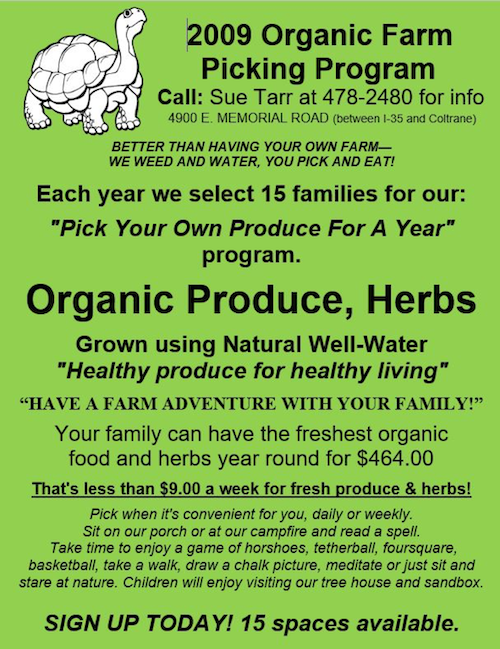
We advertise our picking farm with the flyer shown here. The families who come on our farm tours receive a flyer. Our friends also hand out flyers for us at the Farmers Market.
Turtle Barn Organic Farm has a big bulletin board on the farm at our pickers table. There is a layout chart of the farm beds. The beds are numbered on the chart and on a corresponding number on a tall stick in the bed. As crops mature and are ready to pick, I list the crop and its bed number. I write any harvesting information needed on our clipboard that pickers take with them when they pick. I also place a tall stake with the vegetable name and a long pink fluorescent ribbon on the markers where the crop is located. That way it is easy for families to find the vegetables when they are ripe.
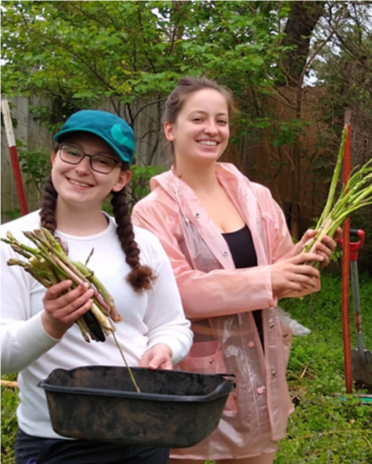
Happy pickers at the farm.
I guide and go with new pickers until they are comfortable harvesting alone and am available if they need coaching by phone. Pickers fill out a Picking inventory sheet each time they pick. I use the Picking inventory as a guide to what and how much to plant each year. Pickers weigh produce and estimate herbs in handfuls.
Pickers pay me for the whole year in advance which comes out to about $9. a week for organic produce and herbs. Since most herbs are perennials, I often have extra volunteer herb plants they can adopt and take home to start their own herb gardens, especially the cilantro and mints.
Q 3. Do I do all the farming myself?
No, Turtle Barn Farm has about an acre under cultivation. At this size, it is way too much for one person to keep up. So, how do I find farm crews and helpers for the farm? There are several avenues we have explored. We first started with friends.
When I began, Don, a 70-year-old man who lives in our garage apartment, and I did all the planting. I was in my 50’s and he was in his 70’s. Now I’m 76 and he’s in his 90’s. My husband had a full time environmental career, so on weekends, he took care of anything weighing over 40 pounds. Don and I took care of the rest. I quickly learned the importance of support and farm crews for the farm.
I’ve had apprentices who paid me to teach them. I’ve mentored many young adults who want to grow their own produce. They are eager to learn from someone who has had more experience.
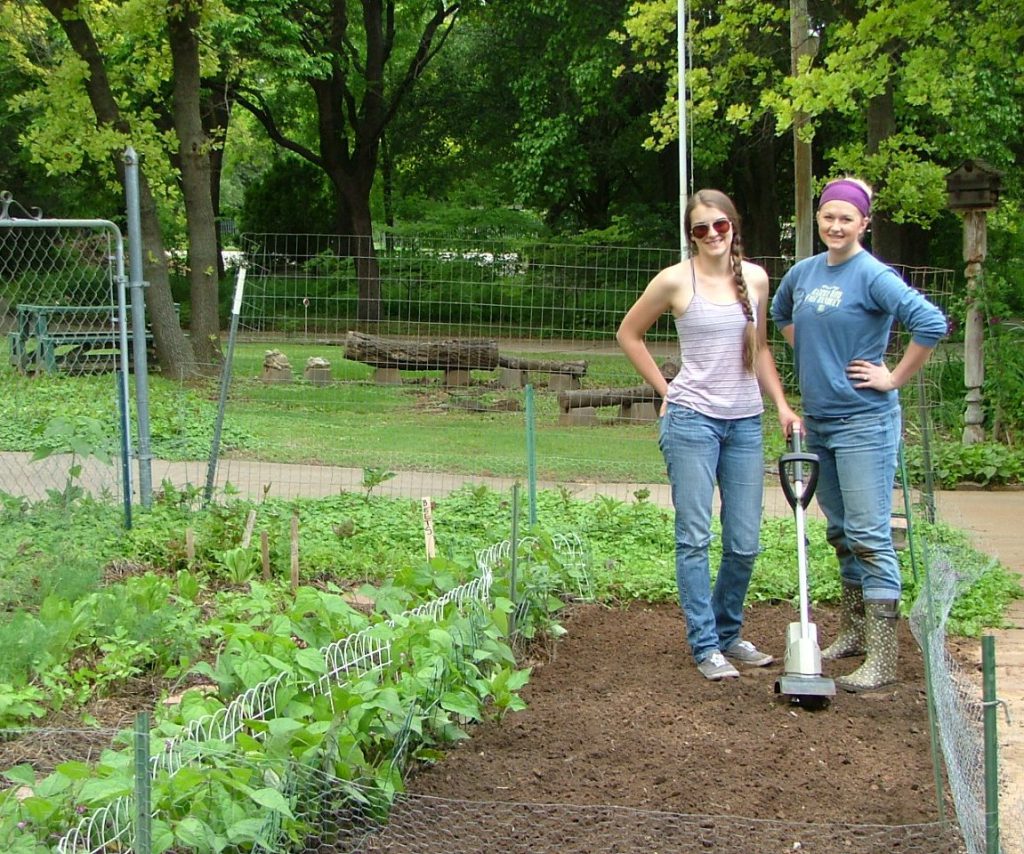
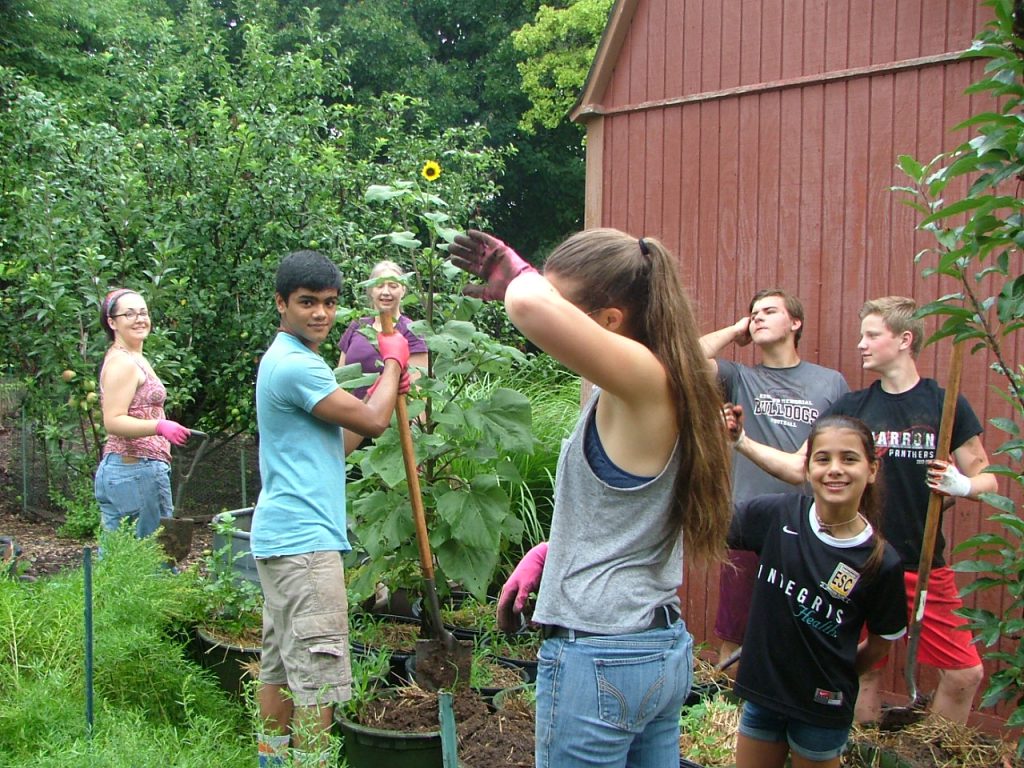
A vocational training High School wanted students to learn organic farming. For many years they brought 15 students out to the farm for 2 hours each week to help create new beds. A lot can be accomplished with 30 hours of farm crew each week! They helped with planting and I taught them organic methods. We do only a little shallow tilling, so most of our digging is by hand, as is seeding and weeding. The students learned a lot and helped us a lot!
I feel we are helping youth learn some gardening skills that will be useful for them in the future and hopefully become our next farmers. Students are making connections with nature on our farm that don’t seem to be happening in their biology class. For example, Harrison, a bright senior in engineering, was amazed to learn that each flower on strawberry plants and apple trees had the potential to become a fruit. He was astonished that adding beehives to our farm increased our crop’s production by almost 50%.
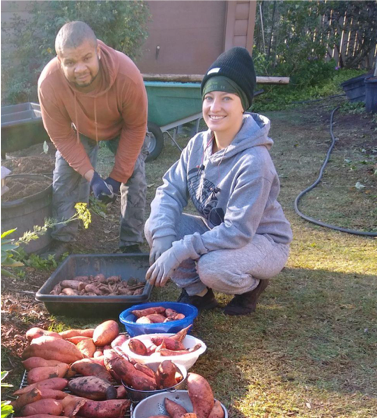
We found many others in the community who wanted to engage in farming. We’ve hired farm crews at Universities, High schools, Junior high schools, Agricultural and Vocational training schools, youth in farm clubs like 4-H, scout groups, International Student organizations, our local Boys Home, churches, and the Hindu Temple. We even had UPS and Amazon Drivers as part of our farm crew!
I’ve had Amma friends stay with us from 1-6 weeks and help on the farm for their room and board. If you have room for someone to live with you, and are willing to provide their meals, there are international agriculture groups who will match you with someone who wants to learn what you have to teach for a few weeks or months. Betty, an Amma friend, has an herb farm and has used several different international agricultural groups for years. She’s had many successful apprentices work on her farm and visit us and work on our farm.
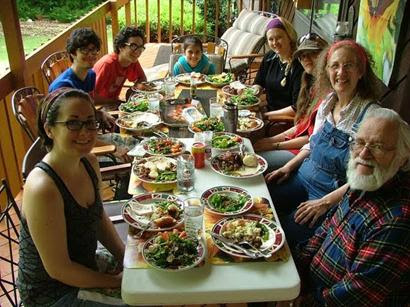
I like to schedule farm crews one day a week and prefer having 2 to 4 workers come for 3 to 4 hours at a time. After the farm crew finishes for the day, I give them a begging bowl and we each go beg and pick our lunch from the farm. Our farm crew lunches create community and allow for so many interesting conversations with people from so many ages and backgrounds.
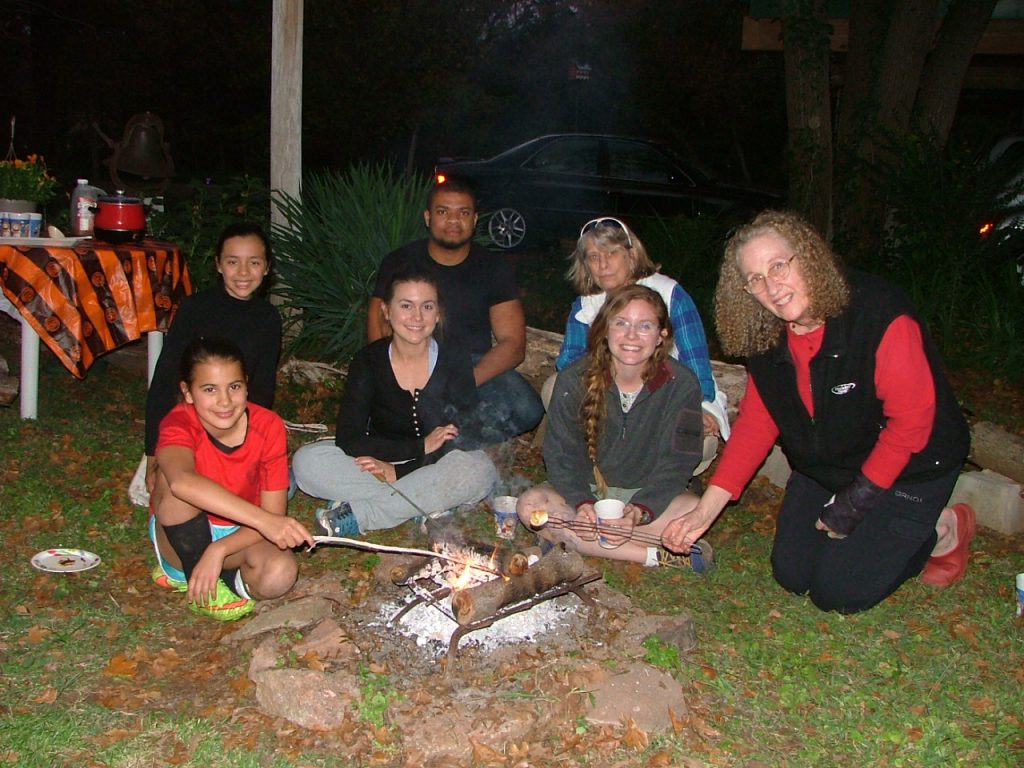
After our final fall harvest, we celebrate with a campfire cookout and singing around the campfire. Amma tells us to make every day a celebration. We’ve created a mini global village with what Amma refers to as Unity in Diversity.
With a heart full of gratitude, I would like to share my journey into natural dyeing with you. I have been doing seva (selfless service) in the textile department in Amritapuri since 2012. Natural dyeing came to me and opened up a world of beauty and wonder. Growing our own plants helped me deepen my connection with the land and return to my ancient roots and a love for the earth. Rejoining with this cycle of life—from seeding, to tending, to harvesting, to dyeing, to stitching and finally, to wearing—reminds us how we once lived and can live again.
Dyeing with plants is an incredible art form. It’s a way to put forth our love and efforts to restore harmony back to the earth. We see that any small effort made to help to reduce the effects of pollution in the world today can go a long way. This is a devotional, creative approach to natural dyeing, with the hope of using it as a sadhana to deepen our bond to the divine.
Amrita Virtual Academy will be offering a series of classes on dyeing with medicinal plants from our garden, herbs, flowers and plants that we have grown here in Saraswati Garden, in Amma’s Ashram here in Amritapuri. We have been growing bamboo, tulsi, aloe vera, neem, turmeric, rudraksha leaves, henna, and we have other herbs and spices, nonni roots, flowers that give us natural color. We have kitchen scraps that you can also dye with that I will be teaching you, like onion peels.You will learn techniques for dyeing other garments in cotton and silk; and you can also explore your own creative ideas with natural dyeing. I’ll also be offering different techniques such as flower bundles, eco-printing, and the basics in block printing. This is a beautiful experience and I am looking forward to sharing it with you.
Anaswara shares her gardening journey: From Houseplant Defeat to U-Pick Farm Victory
I am grateful for the opportunity to share about my 50 year gardening journey with you. It culminated in the creation of Turtle Barn Organic Picking Farm.
My journey began in my 20’s when I couldn’t keep house plants alive. I was really over mothering them with too much water. This was my first lesson in gardening; a little benign neglect could help plants roots grow stronger. A plant’s life may begin in a sheltered greenhouse, yet our goal is to support plants thriving in the wilds of our gardens. Overly sheltered plants develop weak stems and are prone to disease. We want to harden them off so they become strong enough to endure cold and wind.
My backyard produce garden began when I was in my 30’s. I came back from a Llama Foundation Retreat in New Mexico with a “garden calling”. I found myself in Llama’s magical gardens every spare moment I had. When I returned home, I built two 8 by 16 foot raised beds and planted them chock full of vegetables. By the next year, I had converted the rest of our small backyard into vegetable beds and created many herb beds in the front yard. This was the start of something big to come in the future!
When I was in my 40’s, I was so blessed to meet Amma and did a lot of Seva in Amma’s San Ramon, California Center newly started produce gardens in the early 1990’s. I felt Amma graced me with a full-blown gardening transmission. My desire to grow food, care for plants, and share nature with families grew stronger each year I helped in Amma’s amazing Ashram Garden.
When my husband’s environmental career moved us to a new city, we bought a home on a 1 ½ acre lot and created our farm, Turtle Barn Organic Picking Farm. We started turning our Bermuda grass yard into a vegetable and herb garden and planted fruit trees.
One of the parents asked me if I gave farm tours. It sounded like fun, so she brought her Girl Scout Troop for a tour at our farm. All the parents and children wanted to pick produce.They were excited to discover their favorite foods growing and be able to pick them. This farm tour gave birth to our picking farm. We started with 6 families and grew quickly to 15. I guess it was an idea whose time had come for me.
Soon, we had so much surplus produce that I decided to be a vendor at our local Farmers Market. Many of my friends enjoy being vendors, but I did not. I brought a turtle puppet to the market and had fun playing with all the children who came to my booth.
On an Organic picking farm people come to the farm and harvest their own produce. They pay for a year in advance which gives the farmer money to buy seed and hire farm help to care for the plants and soil. Our families love giving their children the experience of seeing how food grows and picking their own food. They love spending time in nature as well.
An organic picking farm can also be done on a smaller scale. If your home’s backyard has only a few produce beds, you could start with one or two friends as your pickers. Or, 3 friends could join and each grow a different crop in their small backyards to share with the other two friends. One could grow produce, the second herbs and berries, and the third fruit trees. All sorts of growing combinations are possible. There are all sorts of possibilities when we are inspired by Amma’s guidance to grow our own food and create community.
Turtle Barn Organic Farm has received much publicity for what is considered an innovative farming approach. Below are some of the news articles, links, and a video about the farm. We hope these will show you possibilities and inspire you to take your next step in your gardening journey.