Many people living in cities, apartment complexes, or housing communities with little or no yard space think that composting is not possible or practical. However, I will demonstrate that composting is possible in even the smallest city apartment.
Mother Nature desperately needs every person to compost – especially those living in the concrete jungles of our world’s major cities!
Amma cleaning the beach after her 2018 Swacchata Hi Seva (Clean India) Address
Amma has said that there was never a mahatma (saint or Realized Being) that ever existed who wasted anything! This is a humbling thought for those of us seeking true spiritual growth.
In the past, I wrote a blog about red worm composting. Although it is possible to maintain a small to moderate sized worm bin in a kitchen or closet, many city dwellers with small apartments or homes may feel there is not enough space for such an endeavor. In addition, if red worm composting seems too “high maintenance” for your liking, I will suggest some easier methods here.
With urban composting – especially in composting experiments which seem limited by space – the first step to full success is source reduction. One of the biggest environmental issues is the vast amount of food rotting in landfills which releases damaging methane gas into the atmosphere.
“In the United States, food waste is estimated at between 30-40 percent of the food supply. This estimate, based on estimates from USDA’s Economic Research Service of 31 percent food loss at the retail and consumer levels, corresponded to approximately 133 billion pounds and $161 billion worth of food in 2010.”
Source: USDA Website
Reducing Your Waste
How sad it is that there are so many people going without food – even starving to death – and 30-40 percent of the United States’ food supply is literally thrown away in landfills.
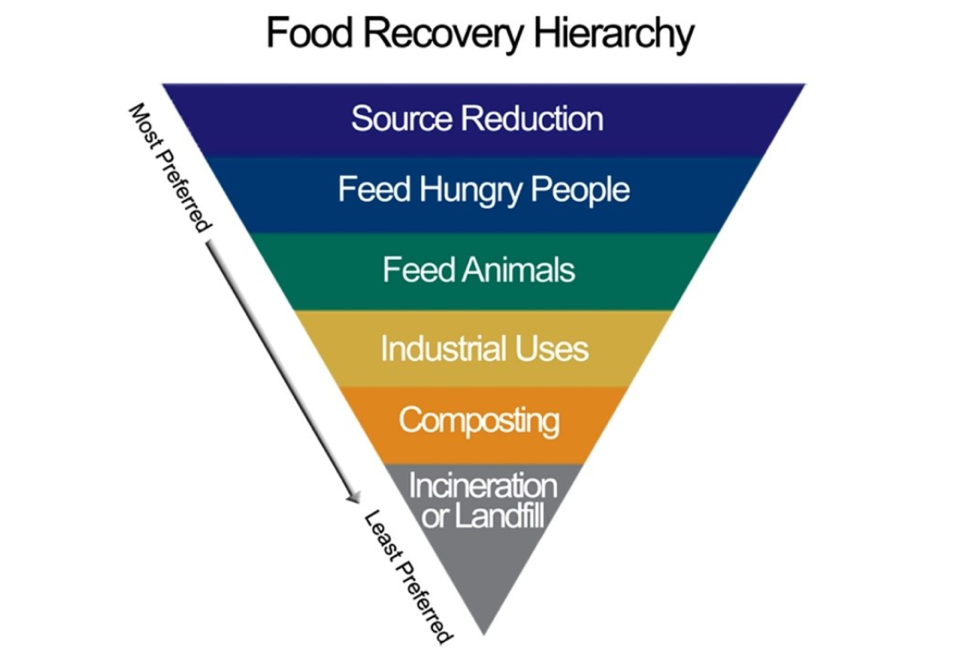
Figure 1: This visual aid was created by the USDA and the EPA; and is referenced from https://www.usda.gov/foodlossandwaste/faqs
According to the USDA, Source Reduction is the preferred method to reducing food waste and the ultimate pollution it causes – more important than composting itself. Source Reduction means that we consciously monitor and reduce the waste we produce at home and at work. Source Reduction is also more ideal than recycling, repurposing, and upcycling.
To grow spiritually, we must learn to take less from the environment and people; and learn to give more.`
Regarding the environment, “giving more” means using less and buying less food per grocery store trip.
Is Composting On A Smaller Scale Even Practical?
Recently, I noticed a dear friend of mine who is concerned about the environment throw away food scraps and some recyclables in front of me. I gently asked her why she was doing this when she truly was concerned about the environment. She responded: “I am convinced that individuals can no longer make a difference unless major companies change their ways.”
My question would be: Well, who supports these major corporations? We do.
Pay attention to where you spend your money. Do some research. Do not support companies that do not have a MINIMAL “green friendly policy” for their company procedures and waste production.
Humans do not like to take responsibility.
It is the Nature of the Ego to want bodily comfort (which generally does not support Mother Nature’s health) and to say: “Well, HE, SHE, or THEY are doing it! What is the use of me trying to compost?” This egoistic idea is, in fact, the impractical, apathetic problem.
In a recent Amritaculture Special Presentation on the “The 5 Elements of Creation,” Swami Shantamritananda Puri spoke on how Amma had said many of Her children would be sent into the world. Swamiji mentioned that Amma said (I paraphrase), “Do not expect to change the world. It is enough if you yourself do not change (in a negative way).” Let us deeply take Amma’s wisdom into our hearts and apply this to Urban Composting!
Do not worry about the scale of your composting experiment. Just do it; and do it sincerely with love for Amma and the Earth. Buy less food per shopping expedition. Notice how much you throw away each day and week. Modify your shopping list as you move forward to reduce your need to compost to the very minimum.
Whatever method of composting you use, even if you compost only a portion of your food waste, multiply that by the 8 billion people on this planet. If we can make it part of our human culture that all humans do this minimal effort, the environment might have a fighting chance to heal. Also, if 8 billion people (or even a quarter of this) decide to not support mega-corporations with no view to environmental protection – how long can those criminal companies stay in business?
Let each of us act on the environmental changes we want to see others doing. Shine for all to see! This is true sadhana (spiritual practice) and true seva (selfless service).
Bokashi Bins
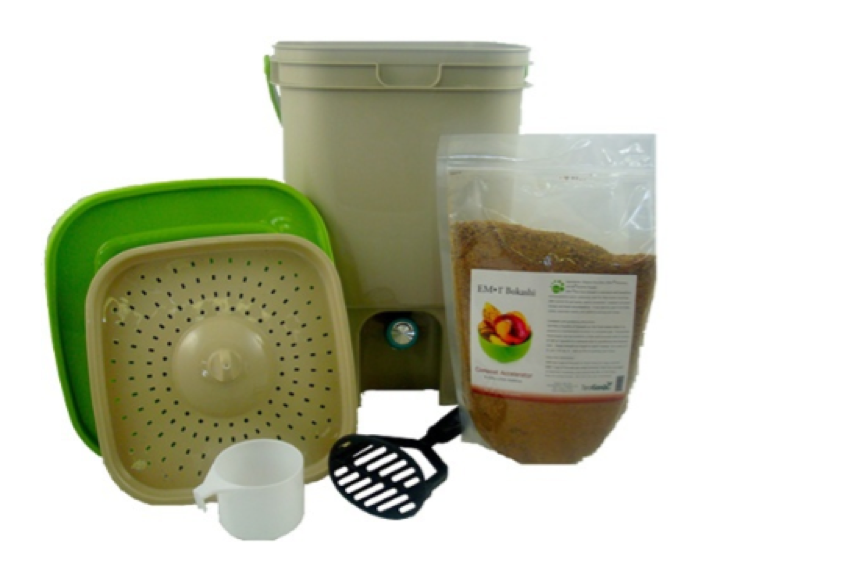
Figure 2: Bokashi Bin packages can be bought online. This photo is from Kenneth Woolridge’s book, “Urban Composting.”
PROS • Bokashi Bins are a very easy method of clean composting that uses minimal kitchen space. • All kitchen scraps (vegetable, meat, and dairy) can go in the bin. Bones are the one exception and moldy foods are not recommended. • It produces a liquid fertilizer which can be added to plants or gardens. • The internal broken-down compost can be added to plants or gardens. • No odors are perceptible.
CONS • There is the ongoing expense of purchasing the Bokashi fermentation mix which you add over layers of compost. Bokashi mix is a sawdust/grain and uses a specially designed micro-organism mix made up of lactic acid bacteria, yeasts, photosynthetic bacteria, actinomycetes, and fungi. • This is an anerobic process of composting which does release some methane gas – not constantly; but when the sealed bin is opened. • Ultimately, things break. The hard plastic parts are recyclable. Look for Bokashi Mix refills that are in paper based packaging instead of the plastic one seen in Figure 2.
Electronic Composters
Figure 3: Pictured above is a Vitamix brand electronic composter. The picture is from Amazon.com.
PROS • There are a lot of electronic composters on the market. • Most brands allow kitchen scraps (vegetable, meat, and dairy) to go in. Bones and fruit seeds (like peach pits) are not permitted for some brands – so read the fine print. • No odors are perceptible.
CONS • They tend to be expensive — $300 USD or higher. You must balance the cost with the ease of use, the fact you do not need repeat purchase of fermentation mixes or liquids, that they do not require bodily strength (like Trench Composting discussed later in this blog), and they are “clean” – no dirt will get on your hands!
• I am suspicious of the length of time these machines last. In our culture, we do not often repair items but through them away. Many areas of the world do not offer electrical appliance recycling. I would hate to see more things piling up in landfills…
To explore more about electronic composters, this YouTube link may be of interest:
Now, we will review urban composting methods which require more effort but have little expense, a onetime expense, or even no expense at all. Not all methods will work for all people.
Soil Crates
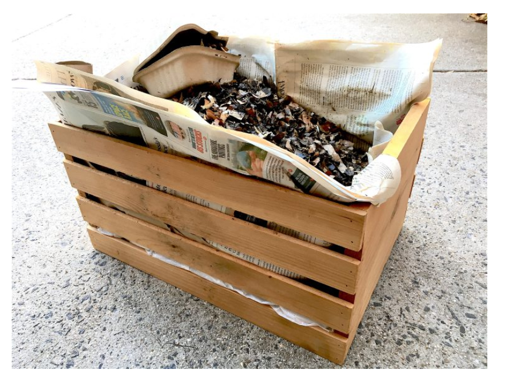
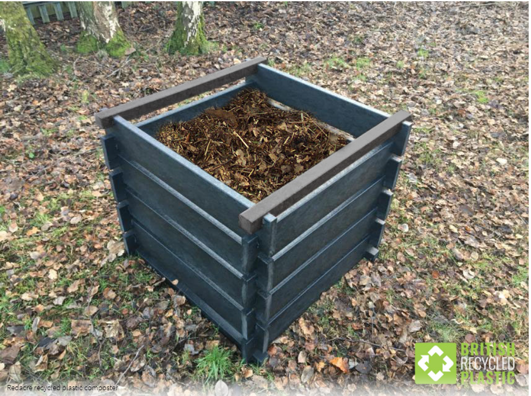
Soil Crates are easy to use and in some of its variations they are very environmentally friendly. Soil Crates are traditionally made from wood – which requires a simple YouTube search for DIY people! Alternately, you can pay a handy friend to make you one. (See hard plastic versions below.)
If you have a small green space or a balcony, this is a marvelous method of composting that is relatively effortless. You DO NOT need a massive soil crate to make a BIG DIFFERENCE.
Create the bin according to your green space’s or balcony’s dimensions.
Add soil. Add food scraps. Done.
Once a week rotate the compost with a hand shovel or a normal shovel. Add water (keep it moist!) Keep it protected and covered from rain.
Insects and micro-organisms will come to help you! Do not add meat, bones, or dairy – otherwise, you will attract rodents, raccoons, and other undesirable animal friends. The food scraps break down relatively fast. The soil becomes “living soil” which can be used for potted houseplants or blended into your garden’s soil.
Figure 4: You can add netting or newspaper to keep soil in your crate or simply construct the wooden bin with smaller space in between the wooden planks. You can make / purchase a wooden lid or not – depending on your preference. This can be done similarly with a milk crate, too! Photo credit: https://findingseaturtles.com/crate-composting/
Figure 5: You can purchase online hard plastic versions of the same with or without a lid.
Pit Or Trench Composting
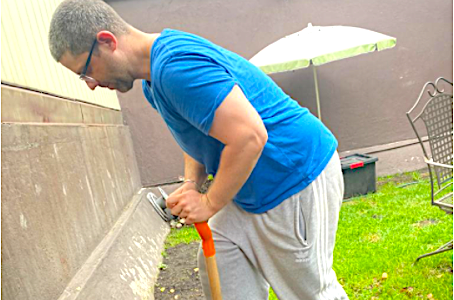
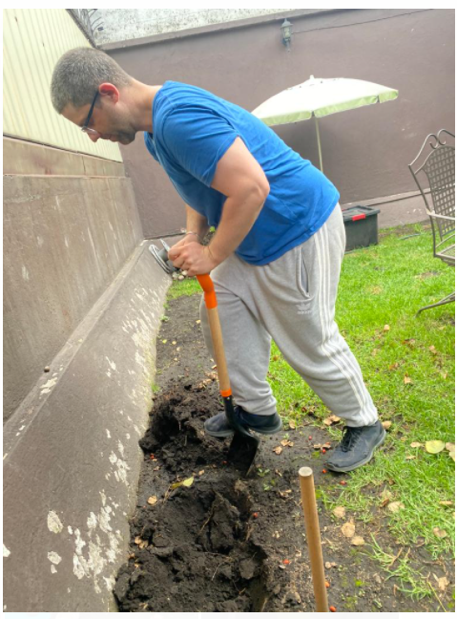
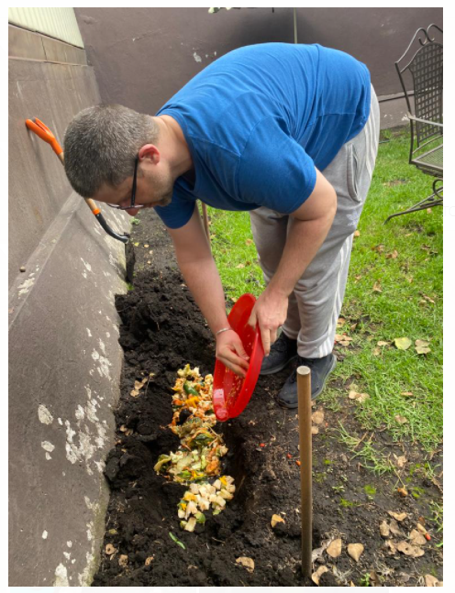
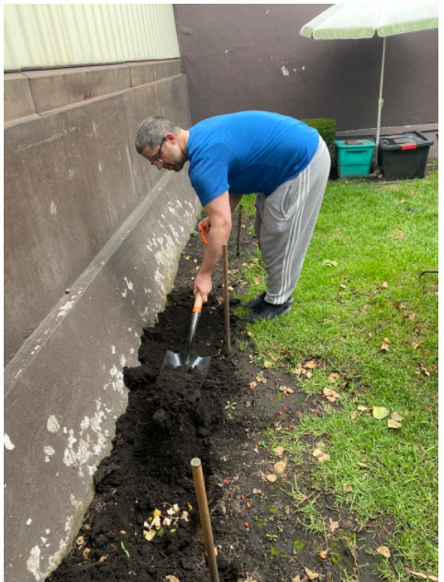
I live right in the middle of the bustling capitol of Toluca, State of Mexico, Mexico – our home base for GreenFriends Mexico! I am fortunate to have a small garden in front of my home. I use trench composting all the time. I have a trench dug and I bury a lot food scraps there. The earth worms love me! The food decomposes shockingly fast which creates living soil rich in composted fertilizer. This soil becomes exceptionally sponge-like, and less watering is needed when I plant veggies and flowers along the trench. When I lived at Amritapuri in 2006, I regularly composted via the trench method which is what inspires me even today to continue doing so. You can also reserve one area of your green space to dig a pit and bury the food scraps in the pit. You can use the same pit monthly over and over. The food scraps will be long gone when you come back!
Some people make more elaborate pits if they have larger green spaces and like the idea (see below).
Figures 6-8: Eknath digging a trench to infill with food scraps and shredded cardboard.
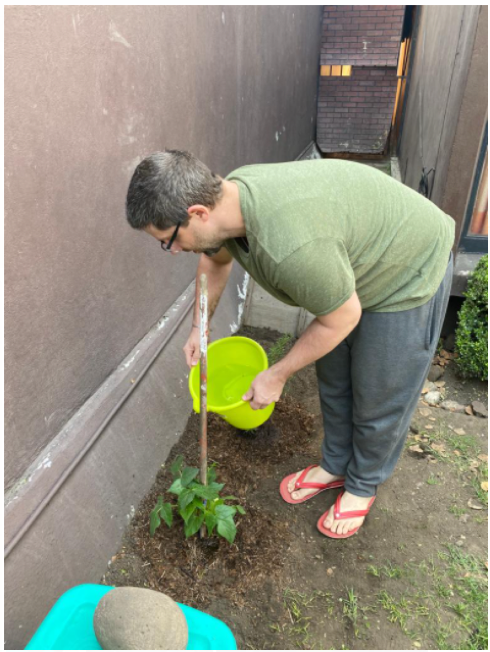
Figure 9: Eknath planting green beans on top of the living soil created by trench composting. Note the red worm compost bin to the bottom left. Eknath uses many forms of composting in his garden and an electronic composter in the kitchen for meats, eggs, and dairy produced by his roommates.
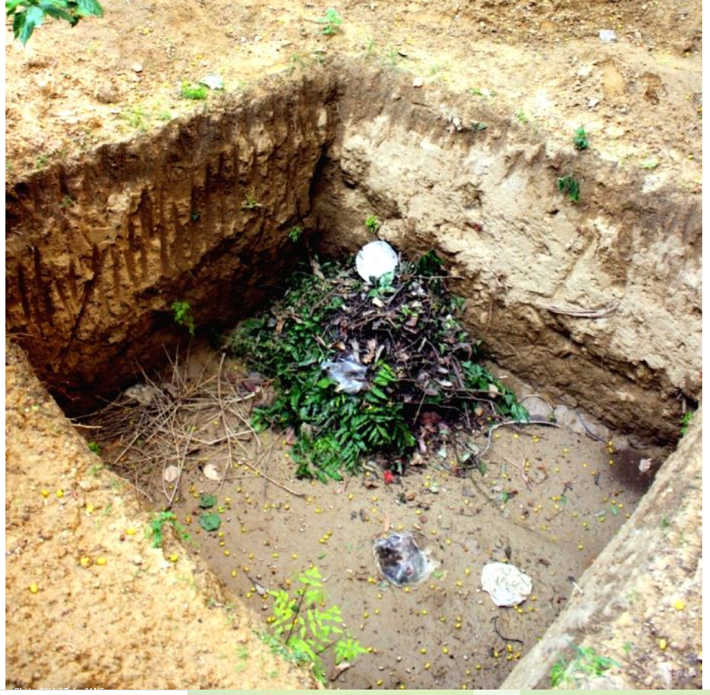
Figure 10: This is a large compost pit dug out in Delhi, India. The dirt is kept aside as food scraps and cardboard are added, a layer of soil is placed on top. A cover of wood or some other device can be used to prevent people from falling in. I have a very small form of this in my front yard in the city of Toluca. Do not ever think that a smaller scale is ineffective! In a tiny pit, I compost a ton of used napkins, food scraps, and cardboard boxes from Amazon or cereal boxes, etc. It works and it works fast! Dried leaves, twigs, and lawn scraps can go in, too!
What Do I Do With All This Compost? I Live In The City!!!
A common concern is what to do with the compost generated in the house. Here are some brief ideas: • Mix your compost in with soil for potted plants in your apartment or urban home • Go on a hike or to a city park and sprinkle it over the grass or at the base of a tree as you chant Lokaha Samastaha Sukhino Bhavantu or your mantra. • Share the compost with neighbors or community gardens in your area. • Trench or pit compost if a small green area is available.
Conclusion
I hope this stimulates many more ideas for you to compost in cities or in homes with little or no green space as this small article does not come close to exhausting all the possibilities out there! Challenge yourself to start a composting experiment today. Offer this to the Divine – without delay!
The Earth needs YOU.
If you have any questions, please feel free to email amritacultureteam@gmail.com. Om Amriteshwaryai, With Love, Eknath
Extreme climate conditions have become the norm. They are no longer a thing of the past. As our planet continues to change and warm, we commonly see more droughts, flooding and extremes in temperature. Here in California, we are facing another summer of extreme drought. In order to continue following Amma’s instructions on growing food, the San Ramon Ashram vegetable gardens have implemented some age-old water conservation techniques.
Saving Water Is Easier Than You Think
Anyone can save water in their garden. These ancient methods have been proven to greatly reduce water consumption and still yield excellent harvests. Along with these practices, there are many other simple water-saving techniques every home gardener should implement in order to have a fruitful garden with low water consumption. One of the easiest things to do in the garden to save water is to water in the mornings or the evenings. This avoids the high noon sun which increases water evaporation. At the end of this article we list several water saving gardening practices.
Drip irrigation is thought to be the most water-efficient method of irrigating a garden, however much of this water is still lost in evaporation, particularly in hot, dry weather. Keeping in mind what Amma says that not a single drop should be wasted, the only way to irrigate effectively is to water deep underground. Bringing water directly to the roots ensures that no water is wasted by evaporating on the surface.
There are several buried irrigation techniques, but here at San Ramon Ashram we chose the Buried Clay Pot irrigation method. This irrigation method has been used effectively for over 4,000 years in India, China and Africa. The pots, also known as “ollas”, can be purchased ready-made such as these to the left. If you have budget to spare, they can also be custom made if one has access to a potter. Fortunately, there is also a simple do-it-yourself method that anyone can tackle and is easy on the budget.
We were fortunate here in San Ramon that a local devotee who is also a potter, donated many ollas for use around the ashram, and they are currently being used to successfully irrigate the Rose Garden as well as all the flower bushes at the Main Residence.
How To Make Ollas
For the Lotus Vegetable Garden, we made over 350 do-it-yourself ollas using simple unglazed terracotta flower pots, water-based, food grade silicone and a little duct tape. Here are some simple instructions for making ollas.
First, seal the bottom hole, with a small piece of duct tape on the outside of the pot. You just need enough tape to cover the hole. Then, fill the hole completely with silicone on the inside, thus plugging the hole.
Second, glue the two pots together with silicone. Once the silicone on the ollas is dry (this usually takes 24 hours), your ollas is finished.
Third, you can bury the ollas in your vegetable garden. Bury the ollas so that only an inch is left above the soil surface, and place a cap of some sort over the top hole. You can use ceramic tiles, stones or inverted flower pot saucers.
Once in the ground, if the tape deteriorates, that is OK as the silicone will hold in place keeping the hole plugged.
Ideally, one olla made of 2 8-inch pots will hold about a gallon of water, and this will irrigate a 4 square foot patch of garden. So, 1-gallon ollas can be placed 2 feet apart, while larger ones can be 3-4 feet apart.
You can hand-fill the ollas individually if you have a small garden, or you can incorporate them into your drip irrigation system by inserting the drip lines directly into each olla, as we did in San Ramon. Take note of the time it takes to fill the olla. Then set your irrigation timers accordingly.
Ollas Can Even Increase Plant Production
The ollas tied to the irrigation system in the garden before planting.
At the San Ramon Lotus Garden we implemented ollas in most of the rows, and were able collect some very strong comparative data as to the conservation of water and productivity of vegetable plants using this irrigation method versus drip irrigation. Two rows irrigated with ollas produced 400 lbs. of vegetables, while comparatively sized rows using drip irrigation yielded only 115 lbs.
Water consumption for the olla rows compared to the drip irrigated rows was roughly 70% less, and due to the fact that the irrigation is strictly underground. In addition, unwanted weeds in the olla rows were almost non-existent compared to the drip irrigated ones due to the lack of surface water.
In the San Ramon Rose Garden, we were fortunate to receive many hand-made ollas from a devotee who is a potter, so these have been buried beside the rose bushes, at least 2 pots per bush, and are providing effective irrigation and greatly reduced water consumption. The roses are thriving!
Due to our warm climate here in San Ramon, the ollas can remain in the ground even through the winter. However, if you live in a northern climate you will have to dig up your ollas, allow them to dry and store them during the freezing months to reuse the next year.
Simple Water-Saving Techniques
Mulch on the main vegetable garden at San Ramon.
If you cannot implement a buried clay pot method, then the following tips will be helpful in reducing your garden’s water consumption, no matter where you live.
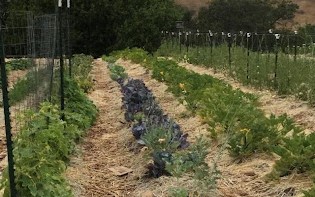
Mulch, mulch, mulch! Adding an organic covering to your gardens helps prevent water evaporation. This can be wood chips, straw, or dried leaves. Make sure the mulch is at least a couple of inches deep to provide the appropriate protection to your soil. Here in San Ramon we mulch with wheat straw and also hardwood mulch.
Water at ground level, not sprinkling. Sprinklers typically waste a lot of water as they are subject to evaporation more quickly that allowing the water to immediately seep into the soil.
Measure how much water you need. Buy a soil moisture reader to determine how often you need to irrigate your gardens. By testing the moisture content of your soil at the root level, you might be able to stretch out your waterings.
Water only mornings or evenings, when the day is cooler and the sun is not at its full strength. This will give the water a chance to percolate down into the soil before evaporation begins.
Use shade cloth if you have very strong, hot sun in your gardens all day. We implemented this in some of our raised beds here in San Ramon and were able to grow cool season crops such as lettuces well into the summer!
Put a water timer on your hose to better understand how much water you are using, and continue to tweak and modify your consumption.
Replace high consumption plants and grass with drought tolerant and native varieties if possible. These will have a greater chance of thriving in your garden under water restrictions.
Shading plants from the sun can save water.
These methods are mostly for more shallow rooted plants and bushes, so for the three fruit tree orchards here in San Ramon Ashram, we are implementing a different system altogether. Look to a follow-up blog post on the details of this method that is specifically for fruit trees and other deep-rooted plants!
How do we take our used clothes and contribute to sustaining the future of our planet? The answer to this question is evolving in inspiring and powerful ways, from our own (often overcrowded) closets to the massive production lines of the fashion industry.
Let’s start with the global clothing and textile sector….
With a creative fire, the concept of upcycling is dawning in the world of fashion—and with good reason. The industry has a critical role to play in achieving the United Nations’ Sustainable Development Goals.
Clothing and textile is a $2.4 trillion-dollar global entity that employs approximately 300 million people across the value chain, many of whom are women, and the scale of the industry is only expected to grow over the coming years.
But alongside, there are currently serious unsustainable practices that include social and environmental consequences. The United Nations Environment Programme states that without major change to production processes and consumption patterns in fashion, the social and environmental costs of the sector will continue to mount.
Facts include:
Fashion is responsible for an estimated 2-8% of the world’s greenhouse gas emissions.
Around 215 trillion liters of water per year are consumed by the industry.
Textiles account for approximately 9% of annual microplastic losses to the oceans.
With its progressive actions that look at how to move forward rather than dwelling on the negative, the UN launched the Alliance for Sustainable Fashion in March 2019. Its participants include members of the fashion industry, environmental organizations and labor groups. They work together to find sustainable solutions that go from raw materials to production to waste streams.
The fashion industry is beginning to evolve in alignment. Partly this must be thanks to the creative ways of thinking in design, as well as the fact that fashion needs people to buy its products. Regardless, it is inspiring to see that upcycled designs have started to appear on the runways with this new social vision. In November 2020, Vogue Magazine published an article that upcycling was the season’s biggest trend. Young independent designers had started long before, making their names by repurposing textiles that already existed. But major luxury brands finally decided to follow suit.
Recutting, redying, reusing whatever old or unsold material they had on hand led to unique items. It was a process that also lay within the context of COVID-19, as new fabric was often not available. In the long run, it will also require the fashion industry to restructure itself overall and that will take time. But at least something has begun.
So how do we take part in this movement within our own daily lives?
It’s easy, but first, the term ‘upcycling’ needs to be clearly understood. Wikipedia, also using the term ‘creative reuse’, says it is the process of transforming by-products, waste materials, useless, or unwanted products into new materials or products perceived to be of greater quality, such as artistic value or environmental value.
The web is teeming with imaginative ideas for DIY upcycling, including for clothes, so this inspired us in Amritapuri to give it a try. As Amma says, “Don’t be discouraged by your incapacity to dispel darkness from the world. Light your little candle and step forward.”
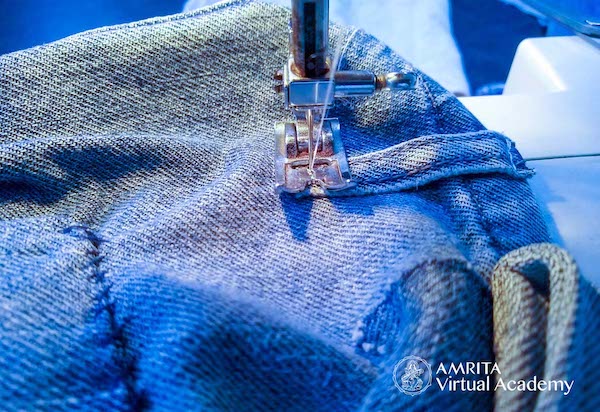
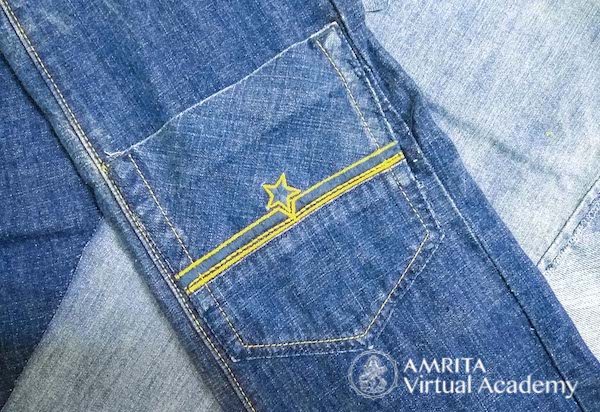
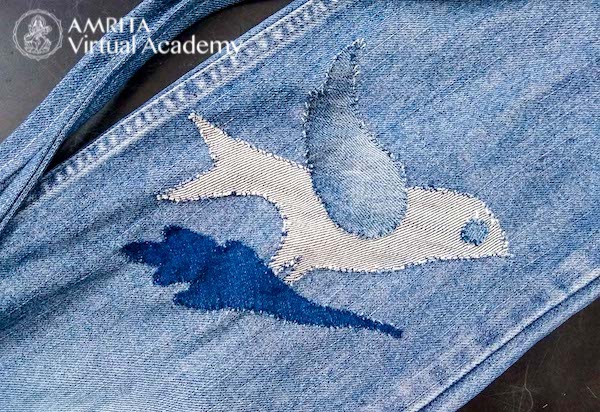
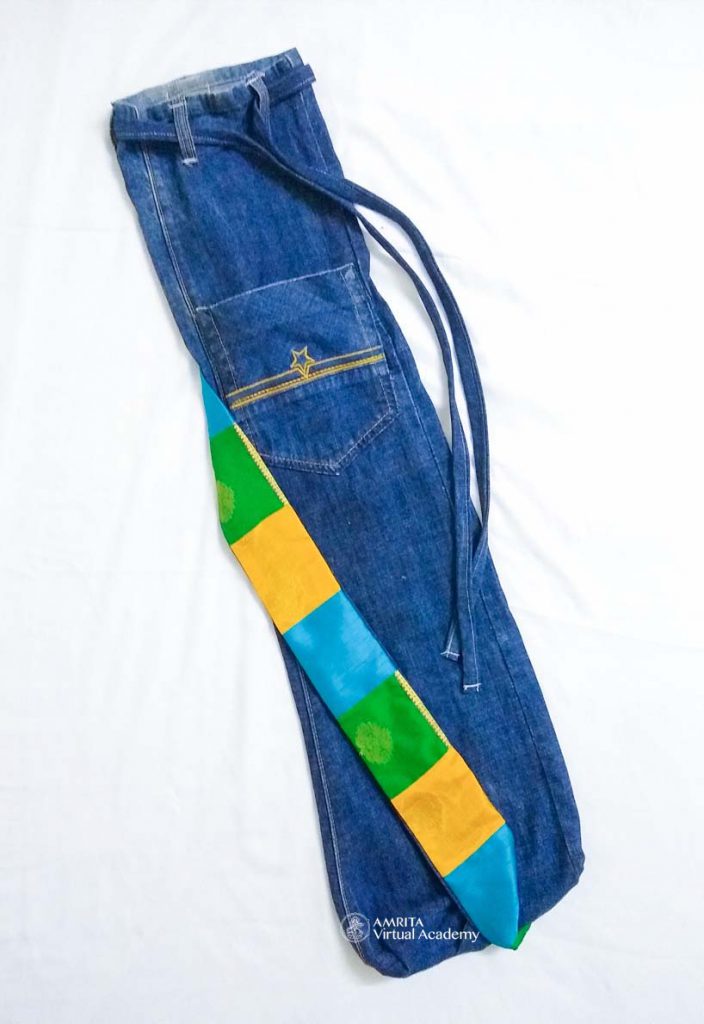
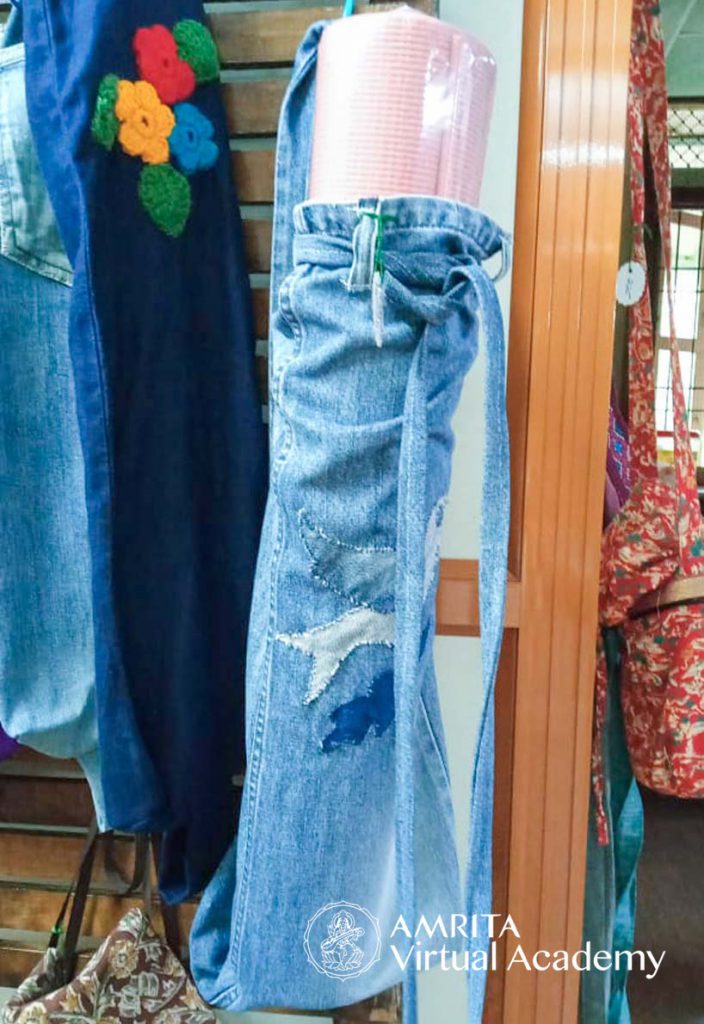
In Amritapuri, people donate a lot of western style pants to Ram’s Bazaar, a place that gives second-hand goods a new life. Yet due to the hot and humid climate, people often do not need them. I came up with the idea to upcycle the unused pants into yoga mat bags for the Ecology Center, as its founding principle is to care for Nature.
The idea for the Ecology Center was presented to Amma in 2004, and Amma enthusiastically agreed. The concept was to educate people about how they could begin to avoid negatively impacting their environment and bodies. Amma immediately said to establish the center in an old house at the Ashram which was being used for storage.
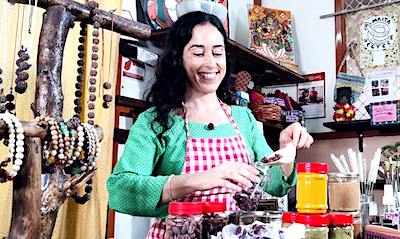
The Ecology Center seeks to offer 100% natural products to replace conventional, harmful chemical products and encourages recycling and saving water. All proceeds go to the humanitarian initiatives of Embracing the World. There is a wide range of ecological choices, including food, body care, books and local handicrafts. The sevites buy in bulk where possible and repack items themselves to promote the optimal use of recyclable plastic containers. They provide certified organic food and fair-trade merchandise.
The Ecology Center also makes its own range of items, from organic nut butters to natural, chemical-free cleaning products for both body and household use. In terms of upcycling, the center has handicrafts made in the Ashram that creatively reuse plastics. Amrita Upcyling makes fashionable and practical items, such as tote bags and wallets, out of what would otherwise be waste.
So in that context, this latest endeavor—the upcycled yoga mat bags made from used clothing—is a hit, especially the bags made from jeans. People from all over the world arrive asking about them.
After a lot of research, I wrote an easy pattern, as trust me, I am not an expert tailor. Since it is based upon the principle of DIY, I decided to share it here. May the Creative Force be with you!
Being involved in civic engagement was NOT my plan. As a matter of fact, I despised anything to do with politics as I had deemed the entire institution corrupt and highly unspiritual. For decades I sat on the sidelines while indulging my ego in jaded cynicism. The truth is, other than voting in the primary election, I never cared to understand or be involved in the democratic process because I was comfortable.
In March 2017 my blissful ignorance came to an end when China announced new legislation called, ‘National Sword’. I suddenly became aware that we (developed nations) had been shipping our trash and recycling to developing nations and dumping it on their doorstep. I was devastated. Then in April 2017, we moved to the Oregon Coast. As I walked the beaches, I noticed millions of pieces of microplastics in the sand that Mother Ocean had regurgitated. She was literally choking to death on plastic! The final (single-use plastic) straw came in November 2017 when I went to India for the first time and witnessed the magnitude of the single-use plastic pollution crisis. Unlike the US, India has no way to hide their waste. The truth was out in the open polluting the streets and waterways and destroying nature. My heart was blown wide open and I knew then, my days of sitting on the sidelines waiting for someone else to do something were over. I needed to stand up, be that someone and become civically engaged.
But I was terrified! I was ashamed that at 50 years old, I didn’t know anything about the democratic process! I was afraid my ignorance would be exposed but my love for nature was greater than my fear, so I was willing. Fortunately, I had been a member of the Surfrider Foundation for years and they are experts in advocacy. I became actively involved and shortly thereafter, was asked to be co-chair on the campaign to ban single-use plastic carry-out bags in my city. I accepted and by default, I was required to interact with and get to know my city council members. In doing so, I realized they weren’t the villains I’d made them out to be. They were people just like you and me! A humbling lesson in contempt prior to investigation.
There were many other spiritual lessons along the way. This process exposed some very deep-seated prejudices and negative tendencies in me that needed to be healed and wouldn’t have been revealed while sitting comfortably on the sidelines. I also gained the kind of ‘Self’-confidence Amma talks about. The kind where we realize we are not the do-er, that God is actually doing everything through us, so then what is there to be afraid of?
On April 15th, 2019, through Amma’s grace and the effort of many, Ordinance #2148 was passed, banning single-use plastic carry-out bags in Newport, OR. The sweetest part of the victory was knowing I was an instrument in affecting change that would benefit my community and Mother Nature. Amma says, “Don’t be discouraged by your incapacity to dispel darkness from the world. Light your candle and step forward.” And when we do, She will be with us every step of the way.
I also invite you to join me for an upcoming live session in which I will share my experience with on getting our local city council to enact a ban on one-time use plastic bags in my town. Link: https://dateful.com/eventlink/2662498938
Click here to enroll in our “Natural Living: Health and Harmony” online course!
Om Namah Shivaya, Everyone! Welcome to my blog on Urban Gardening & Composting coming to you from GreenFriends Mexico!
This month we will continue our discussion on Urban Composting; and we will preliminarily conclude the topic in my next blog coming soon in August 2021 with other specific ways to compost if you live in a city or home with limited outdoor and / or indoor (kitchen) space.
Composting Taboos & Fear of Getting Our Hands Dirty. Ewwww! Composting is gross and smelly! Right? Wrong!
If you learn to compost correctly and start your composting experiments off small, there will be absolutely no smell, no insects, no rodents – all false myths about indoor urban composting!
On June 20, 2021, I offered an Amritaculture Live Q&A Session of Red Worm Composting in urban environments with Hugo Bernal. Here is the link to this session and other amazing offerings from Amritaculture Instructors from around the world which can be found in our YouTube channel (please subscribe!): https://www.youtube.com/watch?v=wLEzMbuW04U
After the session on Red Worm Composting, a dear friend of mine called me. She requested that I write a blog addressing cultural and personal taboos which keep people from composting – particularly for the Asian Indian population who may be less likely to compost. I thought it was an amazing idea for a blog!
There may be cultural taboos and personal prejudices around composting. To be quite clear: Indians are not the only cultural group that may be resistant to composting! People from all backgrounds fall into this category. For many people of all backgrounds, compost bins are imagined to be dirty, full of smelly rotting food, and just plain yucky – who wants to touch that or work with that?!
I have a confession to make. I was that guy until about 2 years ago when I began to experiment with my red worm composting bin, and I fell in love with process as well as other composting projects I will share with you in my upcoming August 2021 blog! Stay tuned and watch for it to learn more!
Many of Amma’s children are from Mother India. Also, millions of Amma’s children globally have been heavily influenced by the thought-world and spiritual biases of Indian culture even when they may have grown up outside of India! It is well known that many Indians would be resistant to composting in general as it is a cultural taboo for Indians to handle dirty things, trash, and (possibly) compost.
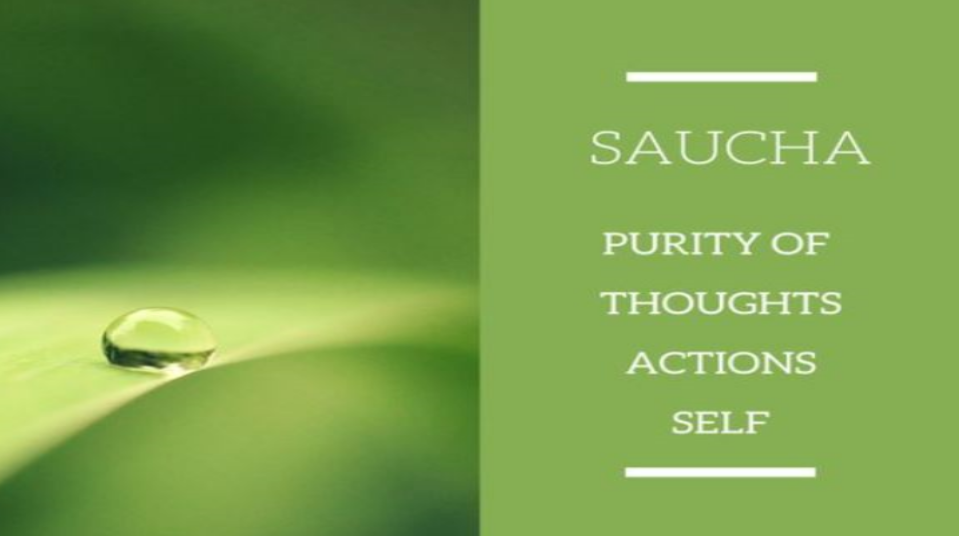
Saucha (a niyama or observance of yoga delineated in Patanjali’s Yoga Sutras) means “purity.” Well-intentioned disciplined spiritual persons from India may be trying to preserve saucha – the conscious practice of inner and outer purity — and that is why they may avoid “dirty work” like composting.
Lord Jesus in the New Testament constructively criticized the spiritual people of His time for being overly concerned about “outer purity.” He smiled to Himself seeing them do lustrations or mikvehs (body washing) before entering the temple (like a devoted Hindu taking a dip in the Ganges three times or more per day prior to doing sadhana).
Jesus pointed out (I paraphrase): “Why are they so worried about washing the outside of the cup instead of the inside of the cup?” By cup, Jesus was referring to the body. We pay more attention to the outside (the body) and not enough to purifying (eradicating) the attachments and aversions which keep us chained to the wheel of samsara.
“He who helps to set up and clean up after a puja attains more merit than he who does the puja.” -Amma
There is the famous story of Amma realizing the Ashram septic system was failing. None of the early residents wanted to go into the septic tank to clean it and get it working properly. Amma – the Purest of the Pure – jumped in first. Of course, when Amma led by example everyone protested, asked Her to stop doing the dirty work, and offered to do it for Her. Amma reportedly did not stop and did the dirty work of cleaning the septic tank with Her truly Divine Hands…
When we do the “dirty work,” although the hands may become soiled – the more soiled the hands become, the purer the hands become; and, the purer our inner and outer realities become, too.
Doing composting seva (inside an ashram and / or in our homes) will be one of the most purifying spiritual practices we can do to conserve the health of Earth and to help Her to heal from the innumerable injuries each of us has caused Her due to our collective lack of education, lack of awareness, and / or lack of personal effort.
I remember living in Amritapuri. I would sweep the trash and do recycling and composting seva everyday all day long. I loved it! I had the divine privilege of serving Amma by helping to keep Her Body (the Ashram) clean! Most of the people doing these sevas noticeably were not of Indian descent. One of the few Indian people doing the seva (who happened to be coordinating the seva) told me, “Amma often says that she admires Her Western children… because they are never afraid to clean and do ‘dirty’ sevas (selfless service).”
I asked my Indian friend, “What do you mean by this?” She said, “It is a cultural thing. Cleaning and dirty work is seen as unsuitable work for many Indians.” Thus, we see a cultural taboo. This should definitively not be taken to mean that ONLY Indians are averted from dirty work due to whatever reason or philosophy.
I lived in the San Ramon Ashram, which has many Western devotees. It is amazing how many of us avoided or “forgot” to take out the kitchen compost, clean the Temple bathrooms, or sweep the dust and cobwebs out of the Temple… Amma has said (I paraphrase): “He who helps to set up and clean up after a puja attains more merit than he who does the puja.” This means that those who do sevas or tasks they view as “unfavorable” or “dirty” get more merit than those who get to do foo-foo sevas or sevas that may seem to momentarily put them in the spotlight. We must never forget that seva is sadhana (spiritual practice that leads to Liberation of Consciousness from samsara).
Composting is seva we can and should do for Amma and the planet in every home. Those who see no task (seva) as below them quickly rise to the top and are examples for all. Amma is the perfect example of this for all of us. No work is lowly. All work (all seva) is valuable. Whether we live in an ashram, offer seva at an MA Center around the world, or manage our own apartment in an urban environment, no work is lowly or unsuitable.
If we do not believe this, we need to carefully reflect on the topic. In yoga philosophy, attachment (raga) and aversion (dwesha) are the two sides of the coin of desire. Desire, according to Lord Krishna in the Bhagavad Gita, leads to suffering, frustration, and lack of spiritual illumination or true spiritual comprehension. If we are seeking spiritual liberation, we must be open to transcending attachment and aversion for the betterment of our families, communities, countries, and the globe.
It is no small exaggeration that if everyone in the world began to compost in their kitchens that we would be well on our way to healing and restoring balance to Mother Nature. To reduce the waste going into landfills should be on the mind of every person (especially if he or she is a devotee of Amma Who constantly is encouraging us to actively participate in source reduction, recycling, tree planting, and organic gardening).
If we are not composting yet because of a negative cultural perception or because we do not want to get our hands dirty, we need to roll up our spiritual sleeves and compassionately observe our egos.
The ego tells us “I want to do only what is comfortable for me. I do not want to do what inconveniences me (composting is time consuming is common false myth). I think it may be smelly or attract bugs or….” We need to educate ourselves, experiment in small ways to see what kind of composting is best for our urban habitats or small modern-day apartments.
In doing so, we will see that if various methods are done correctly in even the smallest confined spaces, there will be no smell, no insects, no rodents, no dirt to speak of. Instead of contributing to the destruction of our planet and the elimination of animal species at a horrifying rate, we can restore Mother Nature’s health and destroy Mahishasura: The Great Ego within all of us.
If any of us truly seeks moksha (union with the Divine), we must go beyond aversion. If we have negative repelling thoughts about urban composting (or composting in general), read about it with a Google search, buy a book on Urban Composting, and learn. What we do not understand we fear or have prejudices about. The world needs you! Let us go beyond all cultural taboos and personal prejudices about composting and give Earth a chance at healing.
The Benefits Outweigh Perceived Issues
Here are some important environmental benefits achieved through composting:
It improves the soil in indoor potted plants and outdoor gardens and green spaces – making the soil “living soil” due to the healthy microbes produced in the compost itself.
* Compost helps to restore and filter local water sources. Compost can retain 5 to 20 times its own weight in water. Adding compost to soil increases the amount of water that can penetrate into the soil. The water can seep all the way down to the impervious rock layer where it wells up and can begin to refill local springs, ponds, and lakes. Via downward drainage through compost, soil, and rock layers, the rainwater is filtered as it makes its way to these water sources.
* Composting Makes Our Oceans Cleaner! All water gradually makes its way to oceans. Compost’s ability to filter water as it penetrates the ground means that the water flowing into the ocean will be cleaner. One of the biggest oceanic pollutants are the nonorganic fertilizers and poisonous chemicals used in farming and gardening.
* Compost reduces erosion of topsoil and “living soil” (that is, soil with compost added to it). One-third of Earth’s farmland has been lost within the last 40 years due to erosion and pollution. Erosion is caused by excess water that is not able to penetrate the ground. Water consequently collects and pools on the surface and rushes down to lower elevations, taking the topsoil with it and depleting the agricultural land. Compost can serve as a sponge and permits much more water to filter down through the ground – thus preserving the topsoil.
* When food waste rots in landfills, it releases methane and carbon dioxide. Organic matter dumped in landfills is the third largest form of methane emission resulting from humans. Composting decomposes our food waste without producing methane emission into the atmosphere.
* Compost reduces carbon dioxide in the atmosphere. To retain microbes in our “living soil,” plant roots will release carbohydrates from their roots to both attract and feed the microbes under the soil. Plants siphon CO2 (carbon dioxide) from the air, absorb water through their roots, and via the science of photosynthesis, turn carbon dioxide into carbohydrates (sugars)! The sugars combined with the microbes that consume them produce humus — a part of the living soil that gives soil its structure, nutrients, and moisture. Humus is largely credited for keeping carbon dioxide beneath the soil.
* Composting saves you money! The average household wastes about $2,200 dollars’ worth of food yearly. When we compost at home, we notice how much food and money we throw away. With this awareness we can buy less and save money; or use the money we have been carelessly wasting to feed the hungry in our communities!
* Composting can create millions of jobs! Advocate in your communities for compost pick up (the same as trash or recycling pick up). When this is successfully accomplished, many people can have good paying jobs while at the same time preserving the health of our local environment!
There are so many wonderful reasons and benefits when it comes to urban composting, they simply cannot be listed exhaustively here in one blog.
Doing an online search or visiting a library is a great way to learn more and to heal the Earth if the topic interests you; or if you need further convincing to get started.
Please stay tuned for my August 2021 Blog delineating “cleaner” ways to compost in small spaces (like indoor apartments or urban homes with little or no green space).
We can make this planet Heaven on Earth. But we must have God’s grace, put in personal effort, and be aware of how our personal positive composting habits can make a big difference!
Please visit the Amrita Virtual Academy blog soon to learn more from environmental and gardening enthusiasts from around the world.
Do you want to join Amma’s Adopt A Seed Campaign? Watch this short video that explains the simple steps you can take right now to help preserve nature’s most precious gift: seeds.
Did You know that we have lost 90% of Agricultural Biodiversity in just the last century? Did you know that Amma has encouraged the preservation of rare heirloom seeds as a way to preserve this Biodiversity? Find out how you can participate by joining “Amma’s Adopt a Seed Campaign.” Diverse SEEDS are the foundation of a healthy and sustainable food system and planet.
This new GreenFriends Initiative is a simple way we can each contribute to preserving resilient, adaptable and biologically diverse seeds for our future generations. If you would like more information on the Adopt a Seed Campaign, please reach out to: amritaculture AT amritavirtualacademy DOT com.
If you are new to seed saving or would like to expand your knowledge, check out our comprehensive course. This unique learning experience includes inspiring Satsangs and Guided Nature Meditations by Amma’s disciples. Gain the skills to save seeds from every major vegetable crop in a step by step progression through every aspect of seed saving! Anyone can become a truly self -sufficient gardener and contribute to the critical preservation of our Earth’s agricultural biodiversity. Guided by experienced gardeners from the sacred grounds of Amritapuri.