Om Namah Shivaya, Everyone! Welcome to my blog on Urban Gardening & Composting coming to you from GreenFriends Mexico!
This month we will continue our discussion on Urban Composting; and we will preliminarily conclude the topic in my next blog coming soon in August 2021 with other specific ways to compost if you live in a city or home with limited outdoor and / or indoor (kitchen) space.
Composting Taboos & Fear of Getting Our Hands Dirty. Ewwww! Composting is gross and smelly! Right? Wrong!
If you learn to compost correctly and start your composting experiments off small, there will be absolutely no smell, no insects, no rodents – all false myths about indoor urban composting!
On June 20, 2021, I offered an Amritaculture Live Q&A Session of Red Worm Composting in urban environments with Hugo Bernal. Here is the link to this session and other amazing offerings from Amritaculture Instructors from around the world which can be found in our YouTube channel (please subscribe!): https://www.youtube.com/watch?v=wLEzMbuW04U
After the session on Red Worm Composting, a dear friend of mine called me. She requested that I write a blog addressing cultural and personal taboos which keep people from composting – particularly for the Asian Indian population who may be less likely to compost. I thought it was an amazing idea for a blog!
There may be cultural taboos and personal prejudices around composting. To be quite clear: Indians are not the only cultural group that may be resistant to composting! People from all backgrounds fall into this category. For many people of all backgrounds, compost bins are imagined to be dirty, full of smelly rotting food, and just plain yucky – who wants to touch that or work with that?!
I have a confession to make. I was that guy until about 2 years ago when I began to experiment with my red worm composting bin, and I fell in love with process as well as other composting projects I will share with you in my upcoming August 2021 blog! Stay tuned and watch for it to learn more!
Many of Amma’s children are from Mother India. Also, millions of Amma’s children globally have been heavily influenced by the thought-world and spiritual biases of Indian culture even when they may have grown up outside of India! It is well known that many Indians would be resistant to composting in general as it is a cultural taboo for Indians to handle dirty things, trash, and (possibly) compost.
Saucha (a niyama or observance of yoga delineated in Patanjali’s Yoga Sutras) means “purity.” Well-intentioned disciplined spiritual persons from India may be trying to preserve saucha – the conscious practice of inner and outer purity — and that is why they may avoid “dirty work” like composting.
Lord Jesus in the New Testament constructively criticized the spiritual people of His time for being overly concerned about “outer purity.” He smiled to Himself seeing them do lustrations or mikvehs (body washing) before entering the temple (like a devoted Hindu taking a dip in the Ganges three times or more per day prior to doing sadhana).
Jesus pointed out (I paraphrase): “Why are they so worried about washing the outside of the cup instead of the inside of the cup?” By cup, Jesus was referring to the body. We pay more attention to the outside (the body) and not enough to purifying (eradicating) the attachments and aversions which keep us chained to the wheel of samsara.
“He who helps to set up and clean up after a puja attains more merit than he who does the puja.” -Amma
There is the famous story of Amma realizing the Ashram septic system was failing. None of the early residents wanted to go into the septic tank to clean it and get it working properly. Amma – the Purest of the Pure – jumped in first. Of course, when Amma led by example everyone protested, asked Her to stop doing the dirty work, and offered to do it for Her. Amma reportedly did not stop and did the dirty work of cleaning the septic tank with Her truly Divine Hands…
When we do the “dirty work,” although the hands may become soiled – the more soiled the hands become, the purer the hands become; and, the purer our inner and outer realities become, too.
Doing composting seva (inside an ashram and / or in our homes) will be one of the most purifying spiritual practices we can do to conserve the health of Earth and to help Her to heal from the innumerable injuries each of us has caused Her due to our collective lack of education, lack of awareness, and / or lack of personal effort.
I remember living in Amritapuri. I would sweep the trash and do recycling and composting seva everyday all day long. I loved it! I had the divine privilege of serving Amma by helping to keep Her Body (the Ashram) clean! Most of the people doing these sevas noticeably were not of Indian descent. One of the few Indian people doing the seva (who happened to be coordinating the seva) told me, “Amma often says that she admires Her Western children… because they are never afraid to clean and do ‘dirty’ sevas (selfless service).”
I asked my Indian friend, “What do you mean by this?” She said, “It is a cultural thing. Cleaning and dirty work is seen as unsuitable work for many Indians.” Thus, we see a cultural taboo. This should definitively not be taken to mean that ONLY Indians are averted from dirty work due to whatever reason or philosophy.
I lived in the San Ramon Ashram, which has many Western devotees. It is amazing how many of us avoided or “forgot” to take out the kitchen compost, clean the Temple bathrooms, or sweep the dust and cobwebs out of the Temple… Amma has said (I paraphrase): “He who helps to set up and clean up after a puja attains more merit than he who does the puja.” This means that those who do sevas or tasks they view as “unfavorable” or “dirty” get more merit than those who get to do foo-foo sevas or sevas that may seem to momentarily put them in the spotlight. We must never forget that seva is sadhana (spiritual practice that leads to Liberation of Consciousness from samsara).
Composting is seva we can and should do for Amma and the planet in every home. Those who see no task (seva) as below them quickly rise to the top and are examples for all. Amma is the perfect example of this for all of us. No work is lowly. All work (all seva) is valuable. Whether we live in an ashram, offer seva at an MA Center around the world, or manage our own apartment in an urban environment, no work is lowly or unsuitable.
If we do not believe this, we need to carefully reflect on the topic. In yoga philosophy, attachment (raga) and aversion (dwesha) are the two sides of the coin of desire. Desire, according to Lord Krishna in the Bhagavad Gita, leads to suffering, frustration, and lack of spiritual illumination or true spiritual comprehension. If we are seeking spiritual liberation, we must be open to transcending attachment and aversion for the betterment of our families, communities, countries, and the globe.
It is no small exaggeration that if everyone in the world began to compost in their kitchens that we would be well on our way to healing and restoring balance to Mother Nature. To reduce the waste going into landfills should be on the mind of every person (especially if he or she is a devotee of Amma Who constantly is encouraging us to actively participate in source reduction, recycling, tree planting, and organic gardening).
If we are not composting yet because of a negative cultural perception or because we do not want to get our hands dirty, we need to roll up our spiritual sleeves and compassionately observe our egos.
The ego tells us “I want to do only what is comfortable for me. I do not want to do what inconveniences me (composting is time consuming is common false myth). I think it may be smelly or attract bugs or….” We need to educate ourselves, experiment in small ways to see what kind of composting is best for our urban habitats or small modern-day apartments.
In doing so, we will see that if various methods are done correctly in even the smallest confined spaces, there will be no smell, no insects, no rodents, no dirt to speak of. Instead of contributing to the destruction of our planet and the elimination of animal species at a horrifying rate, we can restore Mother Nature’s health and destroy Mahishasura: The Great Ego within all of us.
If any of us truly seeks moksha (union with the Divine), we must go beyond aversion. If we have negative repelling thoughts about urban composting (or composting in general), read about it with a Google search, buy a book on Urban Composting, and learn. What we do not understand we fear or have prejudices about. The world needs you! Let us go beyond all cultural taboos and personal prejudices about composting and give Earth a chance at healing.
The Benefits Outweigh Perceived Issues
Here are some important environmental benefits achieved through composting:
It improves the soil in indoor potted plants and outdoor gardens and green spaces – making the soil “living soil” due to the healthy microbes produced in the compost itself.
* Compost helps to restore and filter local water sources. Compost can retain 5 to 20 times its own weight in water. Adding compost to soil increases the amount of water that can penetrate into the soil. The water can seep all the way down to the impervious rock layer where it wells up and can begin to refill local springs, ponds, and lakes. Via downward drainage through compost, soil, and rock layers, the rainwater is filtered as it makes its way to these water sources.
* Composting Makes Our Oceans Cleaner! All water gradually makes its way to oceans. Compost’s ability to filter water as it penetrates the ground means that the water flowing into the ocean will be cleaner. One of the biggest oceanic pollutants are the nonorganic fertilizers and poisonous chemicals used in farming and gardening.
* Compost reduces erosion of topsoil and “living soil” (that is, soil with compost added to it). One-third of Earth’s farmland has been lost within the last 40 years due to erosion and pollution. Erosion is caused by excess water that is not able to penetrate the ground. Water consequently collects and pools on the surface and rushes down to lower elevations, taking the topsoil with it and depleting the agricultural land. Compost can serve as a sponge and permits much more water to filter down through the ground – thus preserving the topsoil.
* When food waste rots in landfills, it releases methane and carbon dioxide. Organic matter dumped in landfills is the third largest form of methane emission resulting from humans. Composting decomposes our food waste without producing methane emission into the atmosphere.
* Compost reduces carbon dioxide in the atmosphere. To retain microbes in our “living soil,” plant roots will release carbohydrates from their roots to both attract and feed the microbes under the soil. Plants siphon CO2 (carbon dioxide) from the air, absorb water through their roots, and via the science of photosynthesis, turn carbon dioxide into carbohydrates (sugars)! The sugars combined with the microbes that consume them produce humus — a part of the living soil that gives soil its structure, nutrients, and moisture. Humus is largely credited for keeping carbon dioxide beneath the soil.
* Composting saves you money! The average household wastes about $2,200 dollars’ worth of food yearly. When we compost at home, we notice how much food and money we throw away. With this awareness we can buy less and save money; or use the money we have been carelessly wasting to feed the hungry in our communities!
* Composting can create millions of jobs! Advocate in your communities for compost pick up (the same as trash or recycling pick up). When this is successfully accomplished, many people can have good paying jobs while at the same time preserving the health of our local environment!
There are so many wonderful reasons and benefits when it comes to urban composting, they simply cannot be listed exhaustively here in one blog.
Doing an online search or visiting a library is a great way to learn more and to heal the Earth if the topic interests you; or if you need further convincing to get started.
Please stay tuned for my August 2021 Blog delineating “cleaner” ways to compost in small spaces (like indoor apartments or urban homes with little or no green space).
We can make this planet Heaven on Earth. But we must have God’s grace, put in personal effort, and be aware of how our personal positive composting habits can make a big difference!
Please visit the Amrita Virtual Academy blog soon to learn more from environmental and gardening enthusiasts from around the world.
Do you want to join Amma’s Adopt A Seed Campaign? Watch this short video that explains the simple steps you can take right now to help preserve nature’s most precious gift: seeds.
Did You know that we have lost 90% of Agricultural Biodiversity in just the last century? Did you know that Amma has encouraged the preservation of rare heirloom seeds as a way to preserve this Biodiversity? Find out how you can participate by joining “Amma’s Adopt a Seed Campaign.” Diverse SEEDS are the foundation of a healthy and sustainable food system and planet.
This new GreenFriends Initiative is a simple way we can each contribute to preserving resilient, adaptable and biologically diverse seeds for our future generations. If you would like more information on the Adopt a Seed Campaign, please reach out to: amritaculture AT amritavirtualacademy DOT com.
If you are new to seed saving or would like to expand your knowledge, check out our comprehensive course. This unique learning experience includes inspiring Satsangs and Guided Nature Meditations by Amma’s disciples. Gain the skills to save seeds from every major vegetable crop in a step by step progression through every aspect of seed saving! Anyone can become a truly self -sufficient gardener and contribute to the critical preservation of our Earth’s agricultural biodiversity. Guided by experienced gardeners from the sacred grounds of Amritapuri.
I used to consider myself an avid recycler. I felt a sense of comfort and even superiority on occasion for being such a good steward of the planet. I would go to other places in the US and scoff when I didn’t see the blue recycling bins anywhere. I bristled with antipathy when I saw people throwing their plastic take-out containers in the trash. Didn’t they know how important it was to recycle? This blissful ignorance carried me along for many years. Until November 2017 when I received an alarming letter from my sanitation company.
The letter stated they would no longer take any plastics other than #1 and #2 PET and HDPE, basically bottles and jugs. What? Why? I immediately called my sanitation company to get the scoop. I was told China was no longer buying our plastic and the local recycling facility couldn’t process them. Wait. What? Back-up, you mean our plastic was being sent to China? Yep. And come to find out, this had been going on for years. How could I not have known about this? Although disturbed, I was leaving for Amritapuri in a couple days so this would have to be tabled until I returned. Or so I thought…
My second day at Amritapuri, I wandered over to the seva desk to find out what my assignment would be while I was there. You guessed it…recycling! I laughed at the irony. I showed up the next day and was in for a shock. I was overwhelmed at the amount of plastic being used and cried throughout my entire shift about the magnitude of human consumption. The beautiful thing about Amritapuri however, is they pretty much have recycling down to a science and approximately 98 % of all their waste is recycled. What a great example to the rest of the world!
“You know, you first have to clean up the plastic and garbage in your OWN mind before trying to clean it up in the world.”
After my seva, I just wanted to forget the pain I had experienced during my shift seeing all of the plastic waste. I decided to head into Vallikavu to take a walk around the town and forget about it. As soon as I reached the boat launch by the bridge, my heart sank. There was plastic everywhere in the water! I was completely devastated. Why hadn’t anyone picked it up? Why weren’t there any garbage or recycling bins anywhere? I was shaken but continued over the bridge into town as I pondered on what to do about the mess.
For a moment, I was able to forget about the garbage and lose myself in the magic of India. I could hear chanting from a nearby temple and tropical birds singing blissfully. The spiritual vibration was palpable and I was taken in by the beauty of Amma’s birthplace. Then I turned the corner and what I saw will remain forever imprinted in my mind. Plastic. Everywhere. Thousands of wrappers from western candy manufactures, water bottles, bags and other plastic packaging choking the waterways and littering the streets of this beautiful, sacred land. In that moment, I was overcome with grief and awareness of how our selfish consumption in developed nations was harming other nations and Mother Nature. In the US, it’s easier to turn a blind eye because we throw our evidence in the blue recycling bin and it magically ‘disappears.’ India doesn’t have the same infrastructure so the dirty truth is out in the open and the truth is, most plastics are not recycled. I had read about this in the news but it was something I needed to witness with my own eyes. I started weeping and talking to Amma as if she was in front of me, “Do you see this, Ammé? Why aren’t you doing anything about it? Something has to be done!” But what?
I was very upset and decided to talk to Swamini Krishnamrita about it. I enjoy talking to her because I know she’ll always be honest with me. I went to her office, sat down and started pouring my heart out. I asked if Amma was aware of the plastic problem in Vallikavu? I mean, she doesn’t get out much because she’s always giving darshan! Maybe she didn’t know! I proceeded to tell Swamini how dire the situation was, asking what could ‘we’ do about the world’s plastic problem? She listened patiently until I finished, then flashed me one of her radiant smiles and said, “You know, you first have to clean up the plastic and garbage in your OWN mind before trying to clean it up in the world. After all, the ‘world’ is only a reflection of your mind. That’s where you have to start.” Speechless, I slowly let the truth of her words sink in. The world didn’t need to change, I did.
Click here to enroll in our Ecology courses inspired by Amma!
I began watching my mind and saw how every judgment was a piece of plastic. Every angry thought, plastic. Every selfish act, plastic. Every feeling of superiority, plastic. Every streak of envy, plastic. Every feeling of self-pity, plastic. I also saw how easy it was to shift the blame and point fingers at causes outside of myself; large manufacturers’ need to change. The recycling industry needs to change. Other people need to change. But then I remembered what Mahatma Gandhi said, “Be the change you wish to see in the world.”
In December 2017, After three blissful weeks at Amritapuri, I came home determined to look at my relationship to plastic in all aspects of my life. I started looking for ways to reduce my use of single-use plastics. I looked into DIY and zero waste options for many products I normally bought in plastic. I started buying in bulk. I looked for ways to reuse or repurpose things I would normally throw away. I was discovering I could do without many things I thought I needed before. I was slowly trying to ‘be the change.’
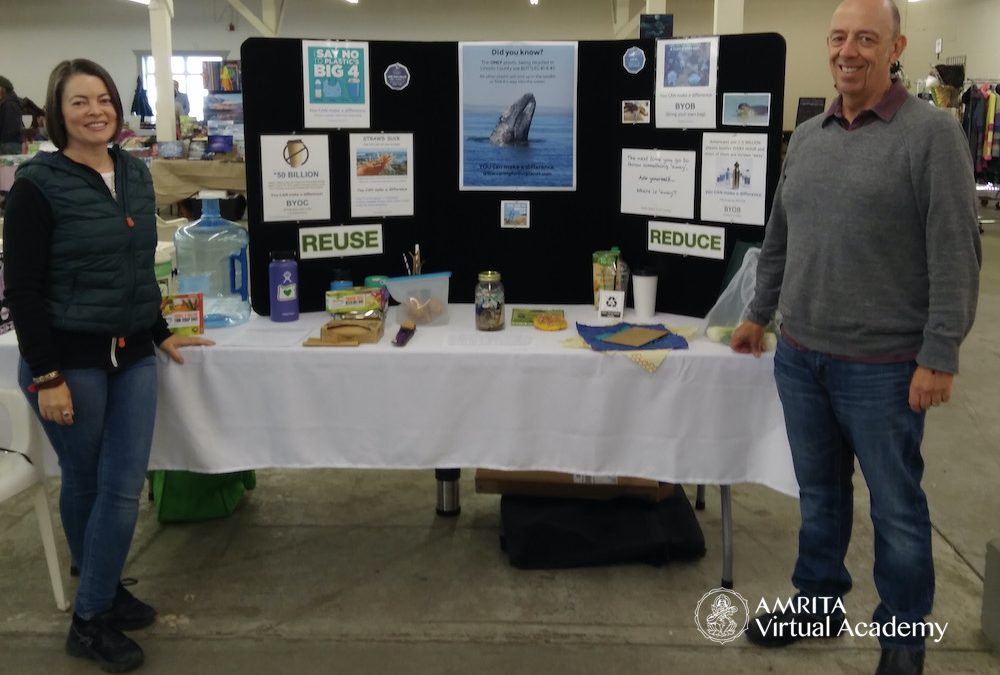
I also became actively involved in my community. I set up a small booth at the local farmer’s market to educate people on the recycling crisis and alternatives to single-use plastic. Many people asked how they could help, so Richard and I created a simple website, caringforourplanet.com, to refer them to. Since I live on the Oregon coast, I got involved with the Surfrider Foundation, a grassroots organization dedicated to the protection and enjoyment of the world’s oceans, waves and beaches for all people through a powerful activist network. Thus began my slow journey (at times, kicking and screaming) into civic engagement and activism. In November 2018, I was asked to coordinate the recycling, compost, waste and sustainability for Amma’s North American Tour.
Through all of this, I’ve had to come face to face with my anger and all the garbage lurking in my own mind. I’ve learned cleaning it up on the outside is the easy part, recognizing it and cleaning it up internally is where the real work begins.
Communicating with nature came into my life quite naturally. The trees were my friends as a child and have brought me solace as an adult. I thought I would share a short inspiration about how talking with the trees helps me in my spiritual and emotional life, supports my creativity and connects me to Amma even when I am far away from Her physically.
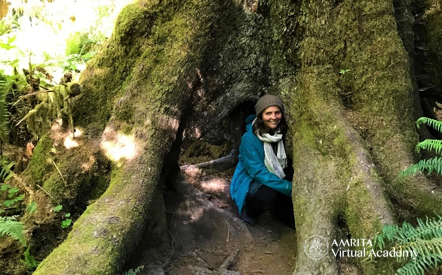
My hometown is London, and I’m lucky enough to live in a very green area (called Greenwich!) with a beautiful park that contains many large old trees. As a child I would play inside these trees (many of them are evergreens with branches that come almost to the ground, creating a separate world “inside” the tree. I would designate different areas to be the bedroom or the living room. I would make ‘cupboards’ in the roots of the trees, or up in the branches, and store my favorite rocks, feathers and petals safely.
After meeting Amma, as my spiritual life deepened, I discovered that being with these trees was much like being with Amma. If I was struggling being apart from Her form, I would visit these trees and hug them. Lie on their branches. Lean against their trunks.
“Being in the space of the trees and flowers connected me to a wisdom that was larger than myself.”
We started to build a relationship, and I would feel them reaching out to embrace me long before I was leaning in to hug the physical trunk of the tree. Every day I would look forward to the moment when I could walk in the park and visit each of my tree friends in turn.
One day I was struggling with something and I spontaneously found myself talking to the tree about it. I felt safe with this gentle giant, and could open my heart fearlessly, knowing I wouldn’t be judged or evaluated against some imaginary standards. To my surprise, the tree ‘spoke back’. Or perhaps more accurately, I discovered that inspiration and insight were easily available in the shelter of the tree’s embrace.
I started to explore this phenomenon. I bought myself a dictaphone (so that I wouldn’t look like a crazy lady!!) and I started recording the information and inspiration that would come. I discovered that if I was willing to be open, and talk freely about whatever situation I was facing, if I was open to the ‘muse’, being in the space of the trees and flowers connected me to a wisdom that was larger than myself.
“It really felt to me like Amma was answering my questions through these incredible tree beings.”
If I needed direction for my work, I would ask the trees what to focus on. If I was sad, I would share my feelings and allow clarity to wipe my tears. The trees became my daily companions. I would seek out their counsel and each day I would be surprised by the depth of insight that flowed back in response to my explorations. It really felt to me like Amma was answering my questions through these incredible tree beings. After participating in these conversations, I would feel such a sense of peace and steadiness, like I was exactly where I needed to be and was right on track.
Since that time, I have continued this practice in various places around the world, wherever my travels carry me. It’s always beautiful to commune with nature, and bring my questions to Her gentle embrace. And yet, the depth of response is not the same without the relationship. Nature is more like a silent witness, holding space for my process, but the responses are generally not as profound as with my deep-rooted tree friendships in that park in London! Perhaps this mirrors our relationship with Amma, because when we feel close to Her in our hearts, we are much more open to following Her guidance in our lives. I pray that one day I can have that depth of friendship with the whole of nature, and see Amma in everyone and everything!
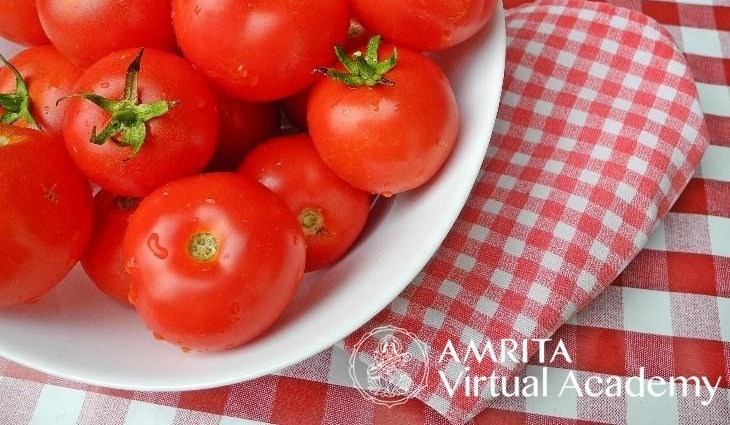
When planting tomatoes one of the first considerations is how far apart should I put my plants. Spacing will be determined by the plant variety you choose. The smaller ones can be planted closer together. Those that get pretty big need room to grow. If you are staking the plants, then you can bring them closer together. General guidelines are about eighteen inches to two feet apart in the rows and about three to five feet apart between rows. It really depends on the variety. If using raised beds that are not walked on, then you can reduce the spacing.
Seedlings, Hardening-off
Seedlings are really essential in almost all parts of the US, as the growing season is not long enough for the plants to fully develop. Seedlings should be started 6 to 8 weeks before you can place them outside. The temperature outside needs to be warm enough, as I stated earlier. When using seedlings it’s important to harden them off by gradually placing them outside and reducing their watering and fertilization and not allowing them to get exposed to cold temperatures in the evening. Covering or sheltering them in the night is very important, as you don’t want seedlings to be exposed to temperatures lower than 60°F. This way, they slowly adapt to the winds and hot sun of the outdoors. Once they have gone through about four or five days of this adaptation, then go ahead and plant them.
If the soil is not warm enough, then place black plastic on the bed to warm it up during the time you are hardening off the tomatoes.
Transplants have been grown in 70° weather. Therefore, putting them in temperatures that are much colder than this is not a good idea, as they tend to develop catfacing (indentations and scars around the blossom end of the fruit versus the stem end. These scars can develop deep inside the fruit. It allows for disease and animals to move in and makes the fruit look really ugly.) Therefore, keep the plants above the temperature in which they are normally grown or very close to it, especially at night, by providing protection until the temperatures outside get into the 70°s F.
Transplanting and Liming Tomatoes
Tomato plants are one of the only plants where you should plant deeper than the soil (3) line in which the seedlings are grown. The transplant should be less than a foot tall. You can dig a trench about four to six inches deep and carefully bend the stem of the plant so the root is at an angle and the actual stem is partially planted, allowing only two or three sets of its true leaves above the soil. The stem will develop roots and establish itself and make the plant stronger.
Before you plant, add about a ¼ cup of lime to the soil where the tomato plants will go. Incorporating this additional lime will help prevent blossom end rot. Use powdered lime, as lime takes time to dissolve and incorporate into the soil. The powdered version will dissolve quicker than the pelletized version. Do this for each plant hole or area right before planting.
Water well once you have finished planting and immediately place the cage or stake into the ground. The stake should be around six foot tall, and placed no more than a foot away from the plant. Do a small application of organic fertilizer or compost tea. Do not over fertilize.
Watering
Regular watering is a must with tomatoes. A good inch or two per week is acceptable, depending on the type of soil. If it’s sandy, then two inches of water is good, during the hot summer days and if it’s a more clay type, then one inch will suffice. The main thing is to keep it evenly moist and not to allow it to dry out. Mulching with straw, partial compost, or shredded leaves is really key, as this will prevent the roots from drying out. Tomato roots are near the surface and can easily be impacted by drought, after which they would immediately begin to develop blossom end rot.
During the hot summer months, it is best to water deeply twice a week or between one to two inches per week in two separate intervals.
Why Do Huge Plants Bear No Fruit or Very little?
The main reason for this is over fertilization. Once the plants are planted in good organic soil and lightly fertilized, it is best to not fertilize again until the plant starts flowering. The reason is that, in the beginning, the plant is in the growth phase. If you fertilize early on, then it stays in this phase. You will get a huge plant but no fruit. Therefore, wait until you see flowering and then give it a side dressing. This makes sure that the plant has moved into a reproductive stage.
Disease and Insects
Blossoom End Rot
This is damage to tomatoes in the blossom end of the fruit. The fruit forms a tan or flat black spot, and then secondary bacteria or fungi enter and cause further damage. Usually, this occurs in hot dry spells.
The cause is a lack of calcium as the fruit develops. This doesn’t mean there is no calcium in the soil but rather it is not available to the plant. Some causes of this are uneven watering; as a result of water fluctuation, the calcium becomes less available to the plants. Excessive fertilization causes the plant to go into a fast growth spur, especially if using non-organic fertilizers that are heavy on salts. Weeding done too close to the plants can damage too many surface roots, and this will stress the plant and not allow it to take up as much water.
The best solution is keeping the moisture even, mulching, avoiding weeding with a hoe or tool at least a foot from the plant, but rather hand weeding.
Growth cracks – the fruit grows very quickly and literary cracks open.
This occurs if you get heavy rains and hot temperatures or if, after having gone through a drought period, all of a sudden you get a lot of water and the growth occurs very rapidly. The cracks are not a problem, as the fruit forms a film and quickly heals itself. The problem is that sometimes bacteria and fungi attack the fruit and cause it to rot.
Click here to learn more about our gardening courses inspired by Amma!
It is best to keep the plant evenly watered, to use mulch, and to use varieties that are less susceptible to cracking. Some good hybrids have been produced.
When using mulch, use straw or any of the others mentioned earlier. If using dried grass clippings, make sure they are not treated in any way with any type of chemicals. Tomatoes are very susceptible to chemicals used on lawns. If plants are exposed, they will grow distorted, or they can twist or just get stunted.
Fusarium wilt, Verticillium wilt, Early blight and Tobacco mosaic virus.
These diseases cause the plant to suddenly wilt and die quickly. They may look different but the result is early death. I feel that, if you grow resistant varieties, it’s the best thing. But if you do grow some heirlooms, there are some varieties that are more susceptible than others, and this is the chance you take.
Keeping the garden free of debris by, cleaning up old plants from the prior year, using a three-year crop rotation, not smoking in the garden and washing your hands after smoking before touching the plants, and disposing of any plants that get infected – versus composting them. The disease resistant varieties are labelled when grown and for the seeds sold.
Pruning of Tomatoes
Intermediate and indeterminate tomatoes are the ones that need pruning due to the vast amount of suckers they send out. The suckers can be from the base of the plant or in between the main stem and the leaves. These suckers develop into full-fledged plants that bloom and produce tomatoes. So why prune them at all?
Many studies have been made to determine the value of pruning. The results are very consistent in showing that pruning will increase your yield, as the tomato plants tend to send so many suckers. These suckers take up a lot of the plant energy by producing lots of leaves and a whole new plant. Therefore, less energy is going into fruit production; instead, it’s all going into making leaves. So, if all the energy is going to produce leaves, there will be less fruit. So many leaves increase the potential for disease due to decrease in circulation and aeration.
But the pruning has to be done right versus just any old way. Otherwise, the yields will be less. Many people think it’s the top that gets pruned, and the tips. This is not the case at all. When you see suckers coming up from the roots or the base of the soil, prune these away. There is one sucker that does not get pruned. You must look for the first flowers to appear.
Once this flower appears, there will be one sucker right below it, no exceptions. This particular sucker does not get pruned. All other suckers between the main stem and the leaf get removed at the junction, except that one right below the first flower.
Why don’t we prune away the one sucker right below the first flower? There have been several studies that found the additional growth hormones that come into play as the plant goes from a growing stage to a fruiting stage are found in great numbers right by the first flower. As a result, they positively influence this sucker, resulting in a very large productive plant that produces lots of fruits. The yield is just as high as the main plant. Proportionally, the fruit ratio is higher than the leaf ratio. Unlike the rest of the suckers, which produce a lot of leaves and less fruit by comparison.
If you observe closely, you will notice that the suckers below this particular first flower – sucker you are leaving behind will be larger than those below it. Despite the fact the other suckers lower in the plant are older and came out maybe a week or two before.
You will then remove all the other suckers growing between the stem and the leaves. You will also remove any suckers from the one sucker that you have allowed to develop, as all suckers behave in the same way as a regular plant. The end result is a two-plant system developing with one root stock. When you stake the main plant, also have a second stake for the extra plant you will allow to develop.
Happy growing!
All photos are copyright protected. Photos 1-4 by Patricia. Photos 5-8 by Marleny.
Ever wondered what happens to your recycling once it leaves the curb? Neither did I until March of 2017 when my waste management facility informed me I could no longer recycle most plastics because China wasn’t taking them anymore. It was a huge wake-up call. I hadn’t been aware my recycling was being sent to China, mainly because I never inquired. As long as it magically went away each week, I felt satisfied I had done my part. Now I know, there is no “away.”
Here’s how it (basically) works: In the US, every city or county has a Waste Management Facility with whom they contract with. These are your ‘haulers’ – the ones who come to the curb, pick up your waste and bring it back to their facility. The garbage is sent to the landfill or incinerator and the recycling is dumped into a big-rig container. Once that container is full, it is driven to the Materials Recovery Facility or ‘MRF’. Pronounced like ‘Smurf’, but with an ‘M’. At the MRF, the recyclables are sorted and the plastics that have a viable market are crushed, baled and most likely shipped overseas. What about the plastics that aren’t viable? No one really knows for sure what is happening to those. I tried calling MRF’s in several cities to ask what their end-markets were. None of them would answer my questions, saying the information was “proprietary.” All I wanted was the truth, but the truth isn’t always convenient.
“Our every action matters to something or someone, somewhere.”
The truth is, only 9% of all plastics ever created have been recycled. Since 1950, we have created 9.2 billion tons of plastic. Of that, more than 6.9 billion tons have become waste. And of that waste, a staggering 6.3 billion tons never made it to a recycling bin, so now we are drowning in it. The great thing about plastic is it’s so durable. The problem is, it’s so durable it doesn’t decompose. It only breaks down into smaller and smaller pieces which we call microplastics. These microplastics can now be found on every beach, in every bucket of water scooped from any ocean, in our sea salt, fish, marine animals, atmosphere, water supply, and in us. It has never been more critical that we heed Amma’s warnings to reduce our consumption of single-use plastics and care for and protect Mother Nature.
What we know today, is there is a still a viable end-market for plastic resins #1 and #2 PET and HDPE – mainly bottles and jugs. They are higher quality and can be more easily recycled or downcycled in actuality. This makes them more profitable and therefore, more desirable. The other types of plastics (#3 – #7) are not easy to recycle or cannot be recycled because they are made from low-quality polymers or have already been downcycled several times. Not to mention most facilities in the United States are not equipped to process them. Additionally, the current low cost of oil per barrel makes it cheaper for manufacturers to use new, virgin plastic than to sort, clean, melt and recycle lower-quality, contaminated plastics. So, what happens to these undesirable plastics?
Well, depending on where you live, the majority are either being landfilled or shipped to end-markets in third-world countries such as Philippines, Cambodia, Ecuador, Vietnam, Turkey, Ghana, Thailand, Bangladesh, Senegal, etc. Right now, alarm bells should be going off. Yes – we are sending our garbage plastics to other countries that can’t even process their own. These developing nations’ are shouldering the burden of developed nations’ over-consumption. So, what are they doing with all of this plastic waste? Good question.
Some of the more viable plastics are melted down and made into “nurdles.” Nurdles are tiny plastic pellets, the size of a lentil or smaller, that serve as the raw material for most plastic products. Due to mishandling and industrial spillage, these pellets are a major source of plastic pollution in their own right. The less viable plastics are piled up in open dump sites, incinerated or processed in recycling facilities, many of which are operating illegally without any regard for the environment or the safety, health and well-being of the people working there.
One of the most important things to realize is when we collect and remanufacture plastic, we are only delaying its disposal as it can only be downcycled so many times. The final destination for all plastic is either a landfill, where it doesn’t decompose, or an incinerator, where it releases harmful chemicals when burned, or the environment in some form of pollution.
So, is there any good news? Well…Yes! YOU are! You CAN make a difference! At the end of Amma’s 2019 New Year’s Message, one of the questions she posed to each of us was, “Am I able to contribute and play my part in protecting the environment?” We can all contribute and play our part if we:
· REFUSE – what we don’t need. Manufacturers’ will stop making when we stop buying. · REDUCE – single-use and unsustainable items. · REUSE or REPURPOSE – what we already have. · REPAIR – rather than throw away, there is no away. · RECYCLE – what we can. · RALLY – your elected officials to pass legislation on single-use plastics.
And remember, no action toward the care, protection and conservation of nature is ever too small or insignificant. Our every action matters to something or someone, somewhere.